BURG CASTLE – A PLACE WHERE THE MIDDLE AGES BECOMES REAL

Some castles are stunning in their opulence, while others are steeped in legend. The Burg Castle near Solingen amazes in a different way. Here, the Middle Ages feel less like a theatrical set and more like carefully reconstructed, living history. One of Germany's largest reconstructed fortresses, a cable car over the Wupper, an interactive museum, magnificent views from the tower, and one of the country's finest heraldic galleries transform a simple excursion into a true journey through time.

It's worth coming for...
The largest reconstructed castle complex in North Rhine-Westphalia – the former residence of the Counts of Berg, restored from ruins as a historical symbol of the entire region
A short flight over the Wupper Valley on the oldest passenger cable car in North Rhine-Westphalia.
Ahnengalerie — Galleries of Ancestors, where coats of arms become not just decoration, but a true textbook of European history.
BURG CASTLE: BEFORE THE JOURNEY

Location: The Burg Castle rises above the Wupper River in the historic district of Burg an der Wupper, on the eastern outskirts of Solingen, North Rhine-Westphalia.
By car. The castle is approximately 40 km from Cologne and Düsseldorf, and about 65 km from Dortmund. Travel time depends heavily on traffic and the final, winding kilometers. There's parking at the upper castle; another option is to leave your car in Unterburg and make the arrival part of the trip.

By public transportation. The nearest stop is Solingen Burg Schloss: buses 266 and, on weekends, tourist line 687 stop practically at the gate. Line 689 also goes up from Unterburg; it's best to check the schedule before your trip.
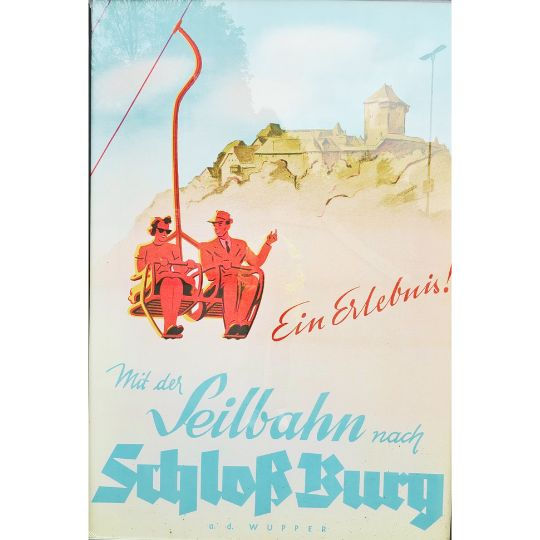
The most beautiful route. From Unterburg, take the Seilbahn Burg lift. A few minutes above the wooded slope and rooftops of the valley allow the castle to appear gradually, as befits a good fortress, rather than suddenly.
How much time to budget. The official estimated tour duration is about an hour and a half, but for a leisurely tour, the interactive exhibition, the Ancestors' Gallery, and the climb to the Bergfried Tower, it's best to allow at least three hours.
Souvenirs. The castle has a souvenir shop where, among other things, you can purchase regional symbols: blades, knives, and other items made from world-famous Solingen steel.
Where to stay afterward. Restaurant Zum Burgnarr is literally located next to the castle. A great place to return to the 21st century after stairs, shields, and ducal ambitions with some solid German cuisine. I've personally tested it: delicious, cozy, and without the feeling that you're being fed solely because of the convenient location.
BURG CASTLE: A HEIGHT FROM WHICH HISTORY BECOMES MORE CLEAR

There are castles that begin to seduce visitors even in the parking lot. Burg Castle is more reserved. It doesn't promise a flawless fairy tale, doesn't coquettishly reflect itself in an ornamental pond, and doesn't pretend to be a country residence accidentally endowed with towers. What you see before you is, first and foremost, a fortress: heavy, composed, subservient to the terrain. And only later does it become clear that its main story isn't about the Middle Ages per se, but about how different eras attempted to understand, appropriate, and rebuild that Middle Ages.
It's best to start from the bottom, from Unterburg. The Seilbahn Burg's retro chairlift ascends the wooded slope almost casually, but the landscape gradually changes scale. The Wupper remains below, the rooftops diminish, and the castle increasingly reveals its true function.

Here, what appears on the plan as mere elevation lines immediately becomes clear: the fortress is built on a mountain spur approximately one hundred meters above the river, with steep slopes on three sides and a relatively accessible approach only from the east. It was here that medieval builders concentrated their moats, walls, and defensive fortifications. Geography here does not serve as a backdrop to the architecture — it is its first and most important element.

Around the mid- 12th century, Count Adolf II von Berg moved the family residence here. In documents, the new estate appeared as Neuenberge — "new mountain." The name was almost symbolic: in the Middle Ages, the authorities valued not only the family's antiquity but also a good view.
Under the Archbishop of Cologne, Engelbert II of Berg (whose monument now proudly stands at the entrance), the fortress became one of the dynasty's main residences. Engelbert was not just a local feudal lord, but one of the most influential figures in imperial politics: imperial governor, guardian of the young King Henry VII, and confidant of Emperor Frederick II.

The old fortified courtyard no longer corresponded to the scale of its power or the demands of a princely court. A new palace, a chapel, reinforced walls, and rooms appeared, in which defensive needs gradually began to coexist with representation. Thus, the Burg gradually became a Burg Castle — the fortress learned not only to protect its owner but also to convey his importance to guests.
Later, the county's political center shifted to Düsseldorf. Burg Castle retained its importance as a hunting and ceremonial residence, but gradually found itself sidelined in history. The Thirty Years' War, the loss of its functions, and a long decline accomplished what sieges often failed to do: by the 19th century, the once-mighty complex was reduced to ruins, its stone salvaged by locals for rather mundane economic needs.

The story could have ended there. But in 1887, the residents of Bergisches Land formed a society to save the castle. Initially, the idea was simply to preserve the remains, but the cautious "let's save what's left" quickly turned into the far more romantic "let's return everything to the way it was." Or, more accurately, how people in the late 19th century thought it should be.
Architect Gerhard August Fischer combined archaeological finds, historical images, regional architectural motifs, and a healthy dose of reconstructive imagination. From 1890 to 1914, what emerged over Wupper Castle was not a literal replica of a medieval fortress, but a Berg National Monument— an architectural portrait of the past, painted by the era of historicism. It was built with donations, lottery proceeds, public collections, and funds from provincial institutions. In other words, the castle was restored not by a dynasty seeking to reclaim its residence, but by a region seeking to reclaim its biography.

It is precisely this contradiction that makes the Schlossburg particularly interesting. It is not authentic in all its stones, but it is surprisingly authentic in the human desire to remember.
The modern museum doesn't try to disguise this multi-layered structure with a vague "antique atmosphere." The route is exceptionally well-designed: courtyards, staircases, a palace, galleries, defensive spaces, and towers are connected to form a coherent narrative.
Visitors aren't left standing in front of rows of objects, forced to experience the historical wonder themselves. The exhibits are presented interactively, precisely, and without the fuss of a fairground: light, sound, digital reconstructions, and carefully measured information help us see the function behind the object, the era behind the function, and the person behind the era.

This is perhaps a rare museum where technology doesn't try to outshine the walls. But from time to time, even the most successful exhibits are outdone by the windows. Through them, the castle constantly draws the eye outward: to the forests, the winding Wupper, the neighboring heights, and the roads of Bergisches Land. Various sections of the route offer almost 360-degree views, and the architecture gradually ceases to be perceived as an independent object. The towers and walls begin to form a unified spatial system —not a picturesque backdrop, but a mechanism for surveillance, defense, and domination.

The final point is the main tower of Bergfried. After the interior halls and staircases, the exit to the observation platform is almost physical: the walls suddenly recede, the space opens up 360 degrees, and individual historical facts finally come together to form a single picture. From here, there's no need to explain why the castle needed this particular mountain; it becomes obvious.
In the Middle Ages, such a view signified control over the roads, the ability to spot danger early, and the right to look down on the surroundings from above, not just geographically. Today, we call it a panorama and pull out our phones. Eight centuries ago, it was called power. And when you look out over the valley from the Bergfried again, it's hard to decide what's more important: the medieval fortress or the relative modernity that has kept it from disappearing.
THE COATS OF ARMS OF BURG CASTLE: HERALDIC ECSTASY

If there's ever a place that can make a heraldry lover forget all about time, it's Ahnengalerie — the Gallery of Ancestors. At first glance, it seems like just a long hall filled with portraits and coats of arms. But linger for a few minutes and you realize: this isn't an art gallery. It's a political map of the Middle Ages. Each coat of arms here isn't just decoration. It signifies a marriage, an inheritance, an alliance, a victory, or a change of dynasty.

It's particularly interesting to trace the fate of the famous Berg lion. After the county passed to Henry of Limburg, who married Irmgard of Berg, the double-tailed Limburg lion appeared on the coats of arms, becoming the new symbol of the House of Berg. This lion would later appear on dozens of coats of arms in the region's towns and remains one of the most recognizable emblems of Bergisches Land.

The most astonishing thing is that the Gallery of Ancestors changes the way we view heraldry itself. A coat of arms is usually perceived as a beautiful shield over a gate. Here, you understand something completely different. For a medieval person, a coat of arms was roughly equivalent to what a family name, a passport, a national flag, and the logo of a large company are today. It spoke volumes about its owner even before they uttered their first word.
And, leaving the Gallery of Ancestors, you catch yourself with an unexpected thought: sometimes a few old shields can tell us no less about the fate of Europe than a thick history textbook.


Comments