FLEVOLAND
Updated: Sep 7

Flevoland is a province where land has been reinvented: from the seabed to architecture, nature and the strange feeling that all of this appeared only recently, but has already become familiar.

FLEVOLAND: ICONIC LANDMARKS
A region where you can walk along the bottom of a former sea, look at 17th-century ship, and not immediately understand which is older here— history or engineering.

Flevoland is the youngest province in the Netherlands, literally "assembled" from water, and this is felt in almost every place: here there is not so much history as a carefully constructed memory of it.
A good place to start exploring it is Batavialand in the capital city of Lelystad, where there is an accurate reconstruction of the Dutch East India Company (VOC) ship Batavia .
This is a rare case where the past was not preserved, but recreated anew, with the same attention to detail with which the province itself was built.

Further on is Oostwardersplassen: a vast nature reserve that emerged from reclaimed land and unexpectedly became one of the country's most "wild" areas. Horses, deer, birds — it all looks like nature returning to a place where it shouldn't be.
A contrast is added by Urk, a former island now "sewn" to the mainland. Here, the old fishermen's houses and lighthouse look almost stubborn, a reminder that water was here not so long ago. And finally, Marker Wadden, an artificial archipelago where nature is not simply preserved, but literally redesigned.
Flevoland generally works as a paradox: the more artificial its origin, the more natural the result feels.
FLEVOLAND: COAT OF ARMS' HISTORY
A land that had to first appear in order to acquire its own history.

The history of Flevoland begins long before the province itself was founded. During the Roman Empire, the site of today's polders was occupied by the mysterious Lake Flevo, or Flevo Lacus, mentioned by the geographer Pomponius Mela as early as the first century AD.
It was likely a complex system of lakes, lagoons, and channels connected to the North Sea. The name itself comes from the ancient Indo-European root "plew-" meaning "to flow," which sounds almost prophecy for the future of Flevoland. Later, the water only advanced: storms and floods gradually transformed the inland lakes into the vast Zuiderzee .
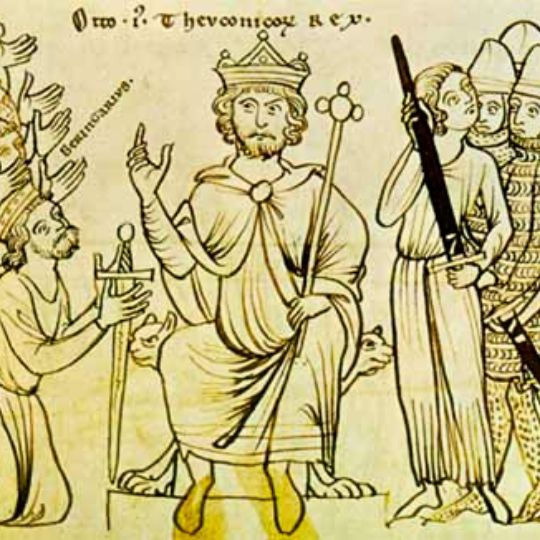
Among this changing geography, Urk stood out — an island first mentioned in Emperor Otto I's deed of gift to the monastery of St. Pantaleon in Cologne in 966 as "Urch in Almere." A remarkable gift, considering that Cologne is almost 300 kilometers from Urk, along convenient and safe medieval roads.
In the Middle Ages, Urk and Schokland existed literally as specks of land amidst water and wind. Today, it's hard to believe that today's fields, roads, and towns of Flevoland were once seabeds, where fishermen navigated by currents rather than trails.
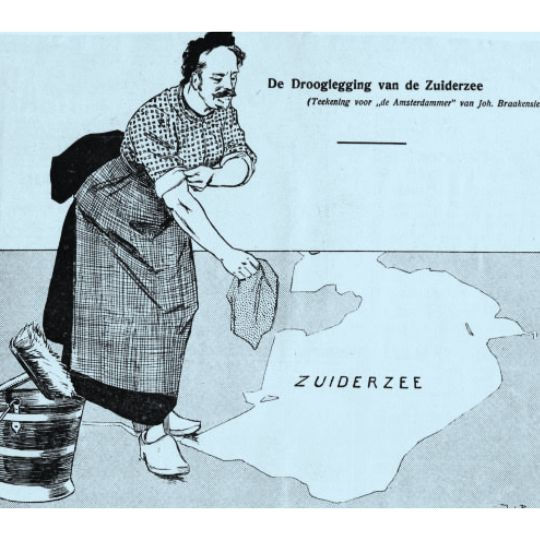
Modern Flevoland emerged from one of Europe's most ambitious engineering projects. After the devastating flood of 1916, the Netherlands finally decided: the Zuiderzee must be tamed. By 1918, legislation had already been passed for a grand drainage project based on the plans of engineer Cornelis Lely.
First, the gigantic Afsluitdijk dam was built, separating the sea from the inland waterway. Then came the creation of polders — artificially drained lands. This is how the Noordoostpolder, Eastern Flevoland, and Southern Flevoland came into being.
After World War II, farmers were resettled here. Roads, towns, and farms were built practically from scratch. Flevoland became a rare example of a region that was carefully planned first and only later began to develop a history, customs, and its own identity.

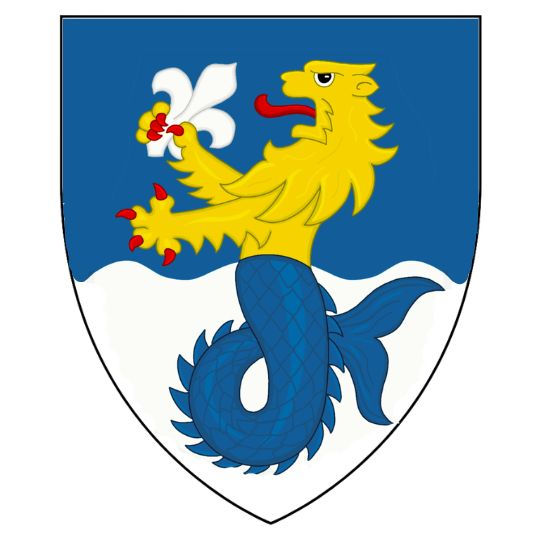
On January 1, 1986, Flevoland officially became the twelfth province of the Netherlands . Its flag and coat of arms were introduced at the same time. By the standards of European heraldry, this is a blatant "novelty." But the paradox is that Flevoland's coat of arms looks as if it has always existed. It fits perfectly into the strict and somewhat conservative line of Dutch provincial coats of arms.
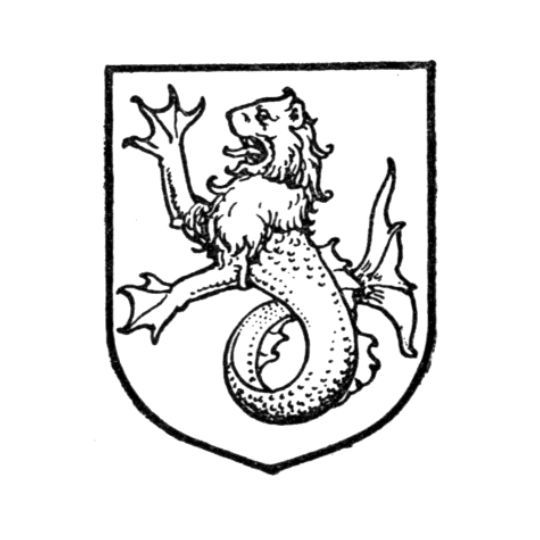
The main figure is a sea lion: a mythical creature with the body of a lion and the tail of a fish. In heraldry, such a symbol traditionally signifies power over the sea, naval prowess, and man's victory over the watery element. For Flevoland, this is an almost literal description of its own biography. The lion's upper part is golden, in Dutch, and its tail is azure — a direct reference to the water from which this land was literally drawn.
At the same time, the coat of arms is restrained and does not attempt to shout about the technological triumphs of the 20th century. Instead, Flevoland speaks in the language of old Europe: the sea can be conquered, but it is better to do so gracefully and calmly.
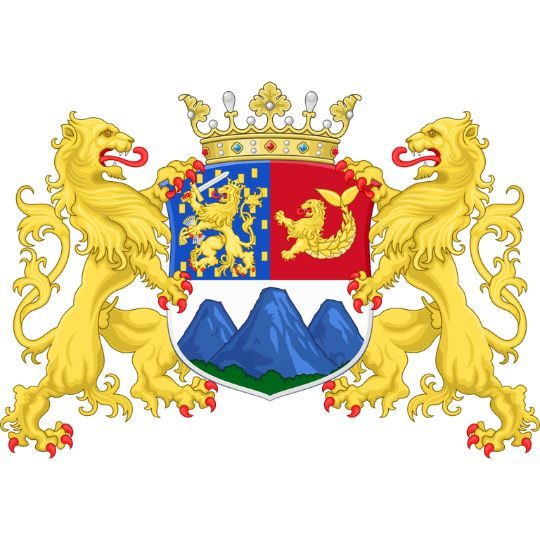
Interestingly, the sea lion is not unique to Flevoland. This figure also appeared in Dutch colonial heraldry. For example, the coat of arms of Bogor, Indonesia, during the Dutch East Indies era, featured a sea lion and the lion of Nassau — the symbol of the dynasty that ruled the Netherlands. Bogor itself was then called Buitenzorg (Dutch for "out of care", or "relaxing") and was the summer residence of the colony's governors-general.
The picture emerges that is quite typical of Dutch history: the sea lion accompanied the country not only in its struggles with the North Sea, but also in its overseas adventures. However, unlike in Flevoland, there it symbolized not the reclamation of lands, but control over sea routes and colonial trade.

The white lily immediately catches the eye on the Flevoland coat of arms. At first glance, it appears to be a classic fleur-de-lis — the famous heraldic lily of French kings, a symbol of power, nobility, and medieval Europe. But there's a subtle Dutch twist hidden here.
In fact, the lily refers not to the monarchy, but to a person — engineer Cornelis Lely. It was his family symbol that was incorporated into the province's coat of arms and flag. Lely was that rare type of statesman whose ideas were initially considered overly ambitious, only to discover that without them the country was literally drowning. He spent decades promoting the Zuiderzee drainage project, enduring political setbacks, changing ministerial positions, returning to his calculations — and ultimately, it was his plan that became the basis for the creation of Flevoland.

The coat of arms of Flevoland is remarkable in that it tells the region's history without a single superfluous detail. The sea lion recalls the land raised from the seabed, and the lily symbolizes the man who devised a way to do so.
And perhaps that's why the coat of arms works so well: it doesn't try to appear more ancient than it actually is. Flevoland honestly acknowledges its origins — yes, we are a new land. But the sea was an old enemy here, which means the legends arose almost immediately.
FLEVOLAND: FUN FACTS
Of how an island woke up and discovered the sea was gone. Or maybe it's not absolutely fun, just a little sad.
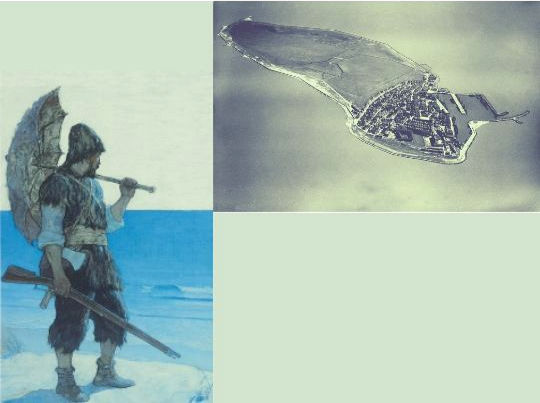
For several centuries, Urk lived as an island — with wind, fishermen, storms, and a very clear sense of where its world ended. And then one day, the Netherlands simply… drained the sea. In 1939, the Noordoostpolder dyke closed, and Urk ceased to be an island. No wars, no disasters, no beautiful mythology — engineers simply shook hands, and geography ended.
There's probably something slightly existential about this. Imagine Robinson Crusoe waking up one morning to find a parking lot, a bike path, and a bus route built to his island. Life has technically become more convenient. But what happens to the island mentality when the island is gone?

That's why Antony Gormley's "Exposition" looks so beautiful in Flevoland — a colossal steel figure (26 meters tall, composed of five and a half thousand steel elements, fourteen thousand bolts) seated by the water in a pensive pose. From a distance, it appears human; up close, it's a chaotic interweaving of metallic lines.
Almost like Flevoland itself: a project that looked perfect on the drawing boards but proved far more complex in the human realm. Gormley created a figure literally pressed into the land reclaimed from the sea. And if the waters one day return, her feet will end up in the water. Or in the earth, if they finish filling the dam.
Perhaps this is why the sculpture creates such a strange impression: it does not celebrate a victory over nature, but calmly reflects on how temporary any human victory can be.
FLEVOLAND: LOCAL HERALDRY
About the elements of the sweet life and their true meanings.

It's no coincidence that the capital of the province of Flevoland is called Lelystad. For the Netherlands, Cornelis Lely is roughly equivalent to a cathedral architect for a medieval city: a man who managed to transform the impossible into a line on a map. Therefore, the coat of arms of Lelystad, adopted in 1979, features a blue shield with a silver lily in the center as a tribute to the engineer who made the province's existence possible.
The rest of the coat of arms evokes a rather unexpected association at first glance: the golden hexagonal pattern is suspiciously reminiscent of a honeycomb. So, somewhere on a subconscious level, you immediately expect an explanation about the "dolce vita," honey, prosperity, and other cozy urbanism. But Flevoland is too practical for such sentimentality.

In fact, the pattern depicts basalt blocks used to strengthen the dams. Not exactly romantic, but honest and beautiful. The entire composition is laid out like a neat engineering drawing, with the gold symbolizing the cost of water protection. The sea lions on the sides remind us that this entire land was once underwater .
And there is a Dutch intonation in this: the coat of arms looks not like an ancient feudal fantasy, but like a beautifully presented report on a victory over geography.


Comments