GELDERLAND


The province of Gelderland – here you can suddenly discover Van Gogh in the forest, a jungle under a roof, royal gardens lined up, and the route will develop itself, without unnecessary explanations or tourist scenarios.

GELDERLAND: ICONIC LANDMARKS
When you have to choose between a zoo, a palace, open spaces, and just relaxing, but you don’t want to.

Gelderland doesn't try to impress with a single blow — it does so gradually and almost imperceptibly. Here, the route itself is self-contained: a bit of nature, a bit of history, and a couple of places that suddenly prove more powerful than expected.
A good place to start is the Hoge Veluwe National Park. It's not a classic "green zone," but a space with character: heather, sand dunes, sparse forest, and a quiet that doesn't overwhelm. Inside, there's the Kröller-Müller Museum: Van Gogh, open-air sculptures, and a sense that art isn't just on display here, but alive.

But the region's biggest surprise is Burgers Zoo in Arnhem. It's not a zoo in the traditional sense, but rather a scientific experiment: jungle, savannah, ocean — all recreated as complete ecosystems. You don't look at the animals — you find yourself in their environment. And that changes the perspective.
And then there's the royal palace Het Loo in Apeldoorn. A palace where everything is laid out with almost mathematical precision: gardens, alleys, symmetry. The former residence of the Orange dynasty, but without excessive pomp — more about control, taste, and order.
Add the capital Arnhem, with its museums and surprisingly vibrant cultural scene, and Nijmegen, the Netherlands' oldest city with a Roman past and a vibrant university atmosphere, and you have a region that doesn't shout about itself but quickly becomes personal.
GELDERLAND: COAT OF ARMS' HISTORY
The province where the dragon gave its name, the sweet fruit is an early symbol, and the lions agreed to look at each other, though not immediately.

Gelderland is one of those territories whose history was shaped not so much by a centralized system as by a succession of possessions, alliances, and dynastic transitions. In the early Middle Ages, these were the lands of Lower Lorraine , which later became the County of Gelre, which became a duchy in the 14th century.
The region's coat of arms, like the province itself, was not created all at once — it was gradually assembled from symbols of power, successful marriages, and equally successful legends.

According to a 15th-century chronicle, the origin of the name "Gelre" stems from the legend of dragon. Two brothers, Wichard and Lupold, heard of a monster living under an old medlar tree. The creature terrorized the area, and the brothers decided to eliminate it. During the battle, the dragon, according to legend, screamed so loudly and shrilly, "Gelre! Gelre!" that it became the name of the future castle built on the site of their victory.

Interestingly, the medlar is not mentioned at all in the early versions of the legend. It appears only in later retellings, when the coat of arms required a symbolic explanation. The medlar itself, in this context, seems almost a metaphor for the region: raw, it is tart and tough, but with time and cold, it becomes soft and sweet. The story thus neatly explains not only the name but also the character of the territory — through a taste that is not immediately revealed.

The heraldic history of Gelre begins not with local symbols, but with dynastic borrowings. After the marriage of Gerard IV to Ida of Boulogne in 1181, the county's coat of arms adopted elements from Boulogne — three circles or spheres. On seals from the late 12th century, these figures already appear as stylized flowers, and later they were finally interpreted as medlar blossoms.
This shift from abstract forms to "botany" is characteristic of medieval heraldry: symbols were not so much fixed as reinterpreted. By the 16th century, the medlar became the official explanation for the old images, and the legend of dragon gained its missing detail — the tree under which it all happened.

After 1236, the Gelderland coat of arms underwent a fundamental change: a golden lion on a blue background — the Gelderland Lion — appeared on the shield. Its origins remain unclear. Two likely explanations are the influence of neighboring dynasties (particularly Nassau) or the use of the lion as a symbol of high military status.
When Gelre was elevated to the rank of duchy in 1339, the lion was given a crown and a second tail — a visual confirmation of the new level of power. Thus, the lion in Guelderland heraldry is not simply a decorative element, but an indicator of the region's political evolution.
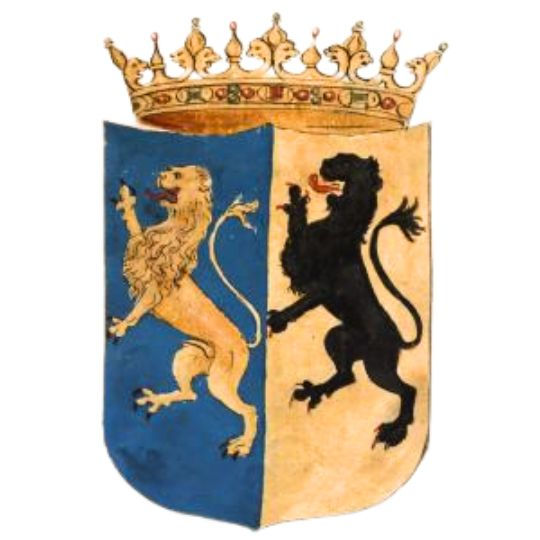
In 1377, the Duchy of Gelre entered into a personal union with the Duchy of Jülich, which is directly reflected in the coat of arms: two lions appear on the shield — the Gelderland Lion and the Jülich Lion. Early depictions show a curious feature: both lions face the same direction, which, from a heraldic perspective, appears more like a technical decision than a meaningful composition.

Later, as early as the 16th century, the lions were turned toward each other. This change can be interpreted as a desire for visual balance and recognition of the equality of the parties in the union. A more informal interpretation suggests a shift from parallel coexistence to interaction. Interestingly, such adjustments in heraldry often occurred post-factum, when political reality demanded a more "harmonious" depiction. In the case of Gelderland, this resulted in the two symbols of power finally beginning to "look" at each other.

The modern coat of arms of Gelderland's, confirmed by Royal Decree in 1935, reflects this historical compromise: two lions on a single shield, each with its own biography, but within a common coordinate system. One is a legacy of Gelre, the other a reminder of Jülich.
The coat of arms appears calm and balanced, although it has a dynamic history behind it. However, as often happens, the final version gives the impression that it has always been this way — which in heraldry usually signifies a well done job.
GELDERLAND: FUN FACTS
Of how the ideal landscape was created on paper, and a knight's tournament was played to the sound of rock hits and a howitzer.

In Edgar Allan Poe's short story "The Domain Of Arnheim," the young heir, Ellison, receives a vast fortune and decides to spend it not on power or influence, but on creating an ideal landscape. Not a garden, but a space where nature and thought converge. The entire action is an almost meditative description of how man attempts to reduce reality to the level of an idea. The literary Arnheim is located somewhere in Holland, on the Rhine — the geography is arbitrary, but recognizable.
And beyond the obvious similarity of the name to the capital of Gelderland, another subtle association arises here: Arnheim: a city that also doesn't strive to impress directly, but gradually "assembles" in the mind — from parks, water, light, and a strange sense of order without pressure. Edgar Allan Poe's vision is of a utopia taken to its limits, almost to the point of human disappearance in its own design. In reality, everything is more modest and therefore more convincing. But after all, we love books precisely for their boundless imagination.

The American movie "A Knight's Tale," starring Heath Ledger, was filmed in 2001 — a rare example of the Middle Ages not pretending to be strict. Knightly tournaments are held to the music of Queen and AC/DC, the branding on the armor alludes to the Nike logo, and the main character is not a nobleman at all, but a former squire who, using a fake pedigree, becomes "Ulrich von Lichtenstein of Gelderland."
The choice of region sounds almost random, but it works: the name is "aristocratic" enough to avoid confusion, and neutral enough not to interfere with the plot. At the same time, Ulrich von Liechtenstein is a very real person, a medieval poet, minnesinger, and knight from Styria, Austria.
Behind the scenes of the film, there's a unique engineering process. Tournament spears were specially sawed, filled with balsa, wood chips, and even dried pasta to create a dramatic flying effect. And the sound of a spear striking a target is a slow-motion howitzer shot. Realism, as you can see, isn't always achieved by straightforward methods. One poster depicts the hero against a double-headed eagle — a direct visual rhyme with the Arnhem coat of arms. Another coincidence, and again, a neat one.
GELDERLAND: LOCAL HERALDRY
There's almost nothing known about how a butterfly appears on one coat of arms and on another, but behind this lies very real money, barons, and nuclear energy.

Barneveld is a municipality in central Gelderland that grew rich not through legends, but through practical things: trade, agriculture, and, in the 17th century, tobacco. It was a tobacco plant that adorned the town's first seal — an honest indication of the source of its prosperity. However, by the end of the 18th century, tobacco had lost its symbolic relevance, and the residents decided the coat of arms needed updating — preferably with a nod to the "enlightenment" and new times. Thus, a strange but evocative scene emerged: a lawn with a plant, above it the sun, and in the foreground, a butterfly emerging from a chrysalis.
Formally, it's a symbol of transformation. Informally, it's a unique case of a municipality voluntarily choosing entomology as its visual language. Later, a small shield with three red columns was added to the coat of arms — an element of the baronial family of van de Schaffelaer, in gratitude for their contribution to the city's development. The resulting coat of arms is a fine archive: a little economics, a little politics, and one very appropriate butterfly.

Dodewaard is a village on the Waal with a history dating back to the 11th century and a name that, at first reading, sounds like a diagnosis. The etymology, however, is more straightforward: "Dode" is a personal name (something like "Dodo"), and "waard" is a plot of land near water. It's a very real "Dodo's domain ," not the literal "Dead value" of modern Dutch. But we'll come back to that.
The coat of arms, granted in 1924, is restrained: on a silver field is a small blue shield with a golden lion and seven blocks in the corner. The remaining space is empty. This is not a mistake or an oversight, but a rare example of heraldic economy: a minimum of elements, a maximum of airiness.
The contrast is heightened by local reality. Dodewaard is home to one of the Netherlands' most famous nuclear power plants. It has been closed since 1997, but will only completely disappear by 2045 — when radioactive decay completes its work. Until then, the plant remains — literally — a kind of "waiting object." And the coat of arms, if one so chooses, can be read the same way: not emptiness, but a pause. Given this fact, the name "Dead value" unexpectedly takes on a new light.


Comments