NORTH HOLLAND
Updated: Sep 7


North Holland is a stunning combination of canals, dunes, sea and cities that once ruled half the world and are now recognizable as the Netherlands on postcards.

NORTH HOLLAND : ICONIC LANDMARKS
Landscapes between the Golden Age and the horizon line that have long become symbols of the country.

If you picture the Netherlands – with canals, windmills, cheese markets, fishing villages and endless dunes – then chances are you're picturing North Holland.
Amsterdam is here, but to reduce the province to just the capital would be about as unfair as considering an entire library to be just one popular book.
A good place to start exploring is Zaanse Schans, a place where the mills don't look like museum exhibits, but continue to do the work for which they were built several centuries ago.
Just nearby is Alkmaar, where the cheese market still resembles a theatrical production based on real events.

In the north of the province lies the island of Texel — a kingdom of dunes, wind, sheep, and wide beaches, where the North Sea looks especially convincing.
Nearby are the ancient port cities of Hoorn and Enkhuizen — former stars of the Golden Age, when East India Company ships set sail from here to riches, adventures, and colonial projects that, from a modern perspective, are rather dubious.
There is also a completely different world here – the Wadden Sea , where twice a day the water demonstrates its own understanding of schedule, revealing huge swathes of the seabed.
And between all this lie tulip fields , ancient polders, the fishing harbors of Volendam and Marken, and the medieval centers of Haarlem and Medemblik. North Holland is remarkable in that almost every landscape seems familiar even before you arrive. Only once you're there do you realize: the postcards are actually telling a very different story.
NORTH HOLLAND: COAT OF ARMS' HISTORY
The Red Dutch Lion, who had to be divided (in order to rule), but when division changes nothing.

Modern-day North Holland is one of the twelve provinces of the Netherlands, but its coat of arms conceals a history far older than the province itself.
The red lion and golden Frisian figures recall the times of counts, naval campaigns, swamp wars, and long disputes over who was truly in charge.
The history of North Holland begins long before the province itself. Back in the 10th century, Count Dirk I received lands around Egmond and became the first ruler of the territory later known as Holland and West Friesland.

His domains were unimpressive: dunes, swamps, flooded lowlands, and a few settlements in relatively dry areas. However, it was from here that one of the most influential counties of the Middle Ages emerged. Gradually, the Dutch counts expanded their holdings, built dikes, founded cities, and exploited the sea.
The red lion appeared on the coat of arms of the counts of Holland in the 12th century. Already under Count Dirk VII (that is, "five Dirks after the first"), it is depicted on the famous seal of 1198.
True, the lion is difficult to spot, but it is this animal that would later become one of the most recognizable symbols of the Netherlands.
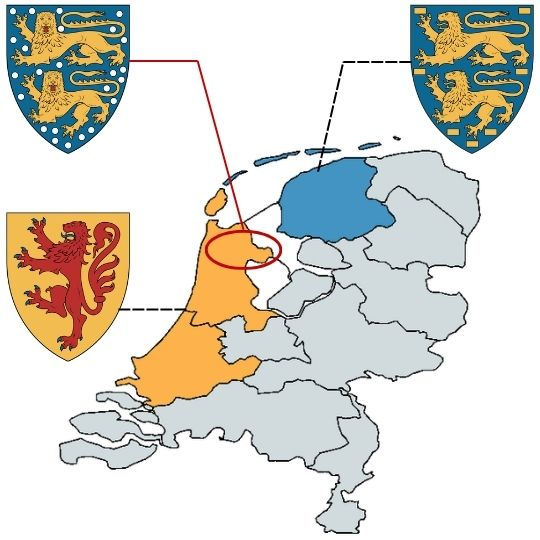
West Friesland often causes confusion. On the map of the Netherlands, there is a separate province called Friesland, located further north, but West Friesland is located within today's North Holland.
Historically, it was part of the larger Frisian world, which once stretched along the entire North Sea coast. During the Middle Ages, the locals long maintained their independence and the famous "Frisian freedom," refusing to submit to the Counts of Holland.
After the conquest, the territory became part of Holland, but its distinct identity was preserved. Even today, the region's residents eagerly emphasize their distinctiveness from the rest of Holland.
The region has its own dialectal features, historical traditions, and a strong sense of regional identity.

The coat of arms of West Friesland is an azure shield with two golden lions and five golden blocks between them.
It is clearly related to the coat of arms of Friesland, which also features lions and characteristic elements commonly associated with the number of historical counties. However, the differences are immediately noticeable.
On the coat of arms of Friesland, the lions move in profile, as befits most self-respecting heraldic predators. The lions of West Friesland, however, unexpectedly look directly at the viewer.
There is no official explanation for this, but it seems as if one is watching over Friesland, the other over Holland, and both are simultaneously ensuring that the neighbors don't start arguing over old borders again.
The result is very Dutch: even the lions here look more like experienced administrators than aggressive conquerors.

The end of the 18th century brought the French era to the Netherlands, and with it a genuine passion for administrative reform.
The old provinces seemed too traditional to the revolutionary authorities, so the map began to be redrew with enviable enthusiasm.
First, Holland was divided into several departments. Then it was reunited. Then it was divided again.
The names Maasland and Amstelland appeared — the first hints at the future South and North Holland. For residents, all this sometimes seemed like an attempt to explain to a river where it should flow according to the new plan.
But it was then that the idea first arose that the old Holland had become too large and influential for a single province. When the country finally became part of the French Empire in 1810, reforms continued, but after the fall of Napoleon, it became clear that some ideas were temporary, and others unexpectedly outlived their author.

In 1840, historic Holland was officially divided into North and South Holland. The reason was surprisingly prosaic: the province had become too large, too populous, and too influential compared to the rest of the country.
Political motives were also at play. Amsterdam and The Hague regularly clashed over the distribution of powers, courts, and administrative functions.
The division made governance more convenient while simultaneously reducing the excessive concentration of power. Curiously, this occurred just a few years after Belgium separated from the Netherlands.
Of course, the scale is incomparable, but history seemed to remind us that even the most familiar borders are not eternal. However, unlike in the Belgian case, no one built barricades or wrote dramatic manifestos. Holland simply became two provinces and the next day went about its business.
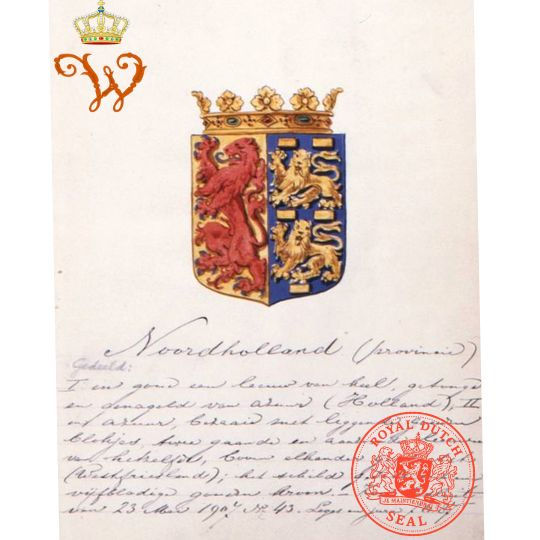
From a heraldic perspective, the division of Holland went largely unnoticed. After 1840, both North and South Holland continued to use the same red Dutch lion for decades.
It wasn't until 1907 that North Holland received its modern coat of arms. Its composition combined two historical legacies: the red lion of Holland and the golden lions of West Friesland. The result was a unique visual formula of the old name — "Holland and West Friesland" .
And this is a beautiful ending to the story. The province was divided, administrative maps changed many times, states emerged and disappeared, but the coat of arms preserved the memory of a time when these lands were still learning to become a single whole. A good coat of arms does exactly what history should do: it reminds not of borders, but of what existed before them.
NORTH HOLLAND: FUN FACTS
About carrots, Dutch courage in a glass and dancing houses in Amsterdam.

If you ask someone what color a carrot is , the answer might seem obvious. But until the 17th century, they were easily found in white, yellow, red, and even purple.
Everything changed during the reign of William of Orange and the Orange dynasty. The young republic became so in love with its primary color that not only its flags but also its otherwise peaceful vegetables became orange.
Dutch farmers bet on patriotic orange varieties, which turned out to be tastier and healthier than their competitors. Gradually, it was this version of carrot that conquered the world. So, if someone munches on an orange carrot today, they are unknowingly participating in a very old Dutch political project.

Continuing with the gastronomic theme, it's worth pouring something stronger. The famous gin originated not in England, but in Holland, in the form of genever — a juniper distillate initially considered almost medicinal.
English soldiers encountered it during the wars of the 17th century and were so taken with the drink that they took it home, along with the name.
Thus, gin was born. Before battle, the drink gave courage, so the English even coined the expression "Dutch Courage ." These days, it's more often a sarcastic expression, denoting the artificial courage that comes from excessive alcohol consumption.

And here's where things get interesting. If you take a stroll through Amsterdam after a couple of glasses of genever (with carrots), you might notice some of the houses swaying slightly. But it might not be the drink.
The famous "Dancing Houses" really are tilted. Much of the city sits on soft peat and clay, and for centuries, the buildings have been supported by millions of wooden piles driven into the ground.
Over time, individual houses have settled differently, creating entire choreographed compositions along the canals.

The result is a striking image: the city is built on water, supported by trees, and appears to be gently dancing to its own history. This is perfectly normal for Amsterdam.
NORTH HOLLAND: LOCAL HERALDRY
When coats of arms begin to tell strange stories.

Katwoude is a tiny village in the municipality of Waterland. Its name is usually translated as "Cat Forest" — from a certain Cat and the swampy forest that existed here in the Middle Ages.
This alone sounds like the beginning of a fairy tale or one of Edgar Allan Poe's most famous stories. Katwoude's coat of arms is equally unusual: it depicts a black cat, perched on a tree. This is rare, almost unique, in European heraldry.
The official explanation is quite prosaic: a play on words between the village name and the animal's image. But sometimes coats of arms prove stronger than their own interpretations.
Because the sight of this cat on the coat of arms conjures up images of witches, swamps, moonlight, and that very story, after which you begin to treat black cats with noticeable respect. He just looks at you and clearly knows something.

It's normal for a symbol's origin to be presented in heraldry with multiple versions. But four versions are practically a literary genre unto themselves. This is precisely how the coat of arms of the Oostzaan community is constructed.
A black trident sits on a golden shield, and at its ends are three green figures, the meaning of which historians have debated for centuries.
These could be cabbages , as the locals were teased as "cabbage boys." They could be cheeses — a memory of a daring naval raid during the Eighty Years' War, when an Oostzaan pirate impaled three cheeses on a handle instead of a Spaniard.
They could be pieces of turf, which were impaled on pitchforks and placed in front of houses — a symbolic renunciation of the obligation to maintain the dykes. Finally, it could be a coded memory of the three medieval churches of Oostzaan and the biblical phrase: "The threefold cord is not quickly broken."
Curiously, each theory seems quite plausible. That's why, centuries later, the Oostzaan coat of arms resembles a good detective story: there are many suspects, the motives are compelling, and yet a definitive answer remains elusive.
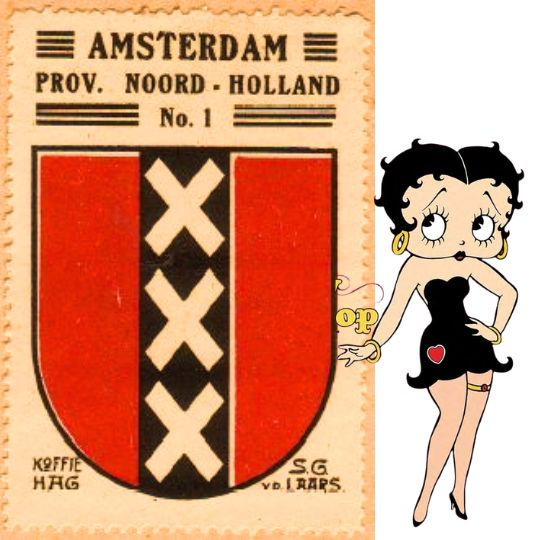
If there's a coat of arms that has inspired more urban legends than tourist attractions, it's the coat of arms of Amsterdam.
The three silver crosses of St. Andrew on a black stripe date back to the Middle Ages and are likely connected either to the holdings of the Perseyn family or to ancient legal symbols denoting law and order — three crosses were drawn in chalk on a black court table at the beginning of a trial and erased afterward.
There are also versions about water, fire, and plague, about fords across the Amstel River, and even about windmill blades.
However, the modern world is such that many visitors notice something quite different. A city with a red light district, coffee shops, and a reputation for being a little too permissive is adorned with three large Xs .
And the gullible tourist immediately concludes that this is some kind of medieval XXX category logo. Of course, the coat of arms has nothing to do with such associations. Moreover, it predates both the adult entertainment industry and the very concept of XX or XXX ratings by many centuries.
And this is the irony of history: a symbol created as a sign of law and order is today perceived as an advertisement for the exact opposite. Amsterdam has long since stopped arguing with this and simply watches on with a slight smile.


Comments