THE NETHERLANDS
Updated: Sep 7


The Netherlands is a country that has been battling with the sea for centuries, building cities on stilts and combining the audacity of an engineer, the patience of a farmer and the serenity of a man confident that every storm always ends.

THE NETHERLANDS: ICONIC LANDMARKS
The Netherlands is a country that is constantly changing its landscape, but somehow manages to retain the memory of every step along the way.

First, let's agree on terminology. Holland and the Netherlands are not exactly the same thing.
Holland was historically only part of the country and is today divided into North and South Holland.
But it was these provinces that, during the era of trade, navigation, and colonies, made such a strong impression on the world that their name gradually came to refer to the entire country.

The Netherlands' iconic landmarks are well known: Amsterdam's canals, museum districts, the windmills of Kinderdijk, tulip fields, the ancient cities of Delft, Haarlem, and Leiden, the seawalls of Zeeland, futuristic Rotterdam, and the village of Giethoorn, where a boat still looks more natural than a car.
But what's curious is that almost all of these landmarks emerged not in spite of circumstances, but because of them.
Windmills here aren't just romantic decoration. Canals weren't built for postcard beauty, but as part of a centuries-long battle with water.

Dams were built because the alternative was to live on the seabed. Even the famous tulips were once an expensive economic gamble.
That's why the Netherlands leaves a strange impression. At first glance, it's a calm, orderly, and rational country.
But take a closer look, and you realize that a significant part of it arose thanks to people who once looked at a swamp, a tide, or a storm and said, "No, there will be a city here after all."
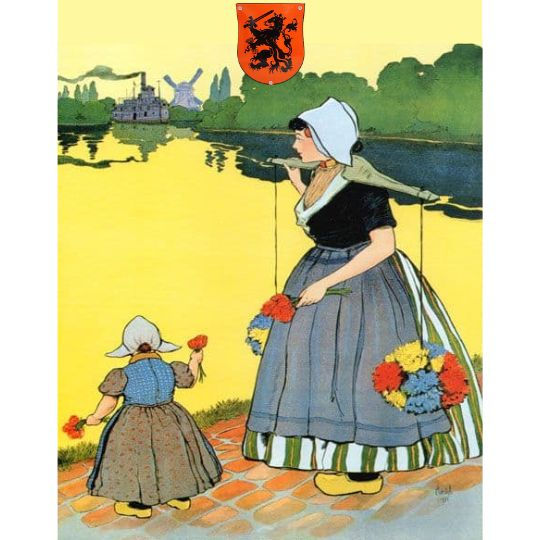
Thinking about Holland,
I see broad rivers
moving slowly through
endless lowlands.
rows of unthinkably
thin poplars
standing as high plumes
one above the other;
and sunken within
wonderful space,
farm houses
scattered throughout the land,
clusters of trees, villages,
cropped towers,
churches and elms
in one great association.
the air hangs low
and the sun is slowly
muffled in a gray
mottled fog,
and in the many provinces
the voice of the water
with its eternal calamities
is feared and heard.
"Herinnering aan Holland" / "Memories of Holland" (1936) by Hendrik Marsman has been voted the 'Poem of the Century' by readers of Dutch mass-media in 2000.
THE NETHERLANDS: COAT OF ARMS' HISTORY
The lion who learned to hold the country.

The history of the Netherlands begins long before the country of that name. Germanic and Celtic tribes inhabited the Rhine delta, and the southern lands came under the orbit of the Roman Empire.
The Batavians, a tribe from the lower Rhine region, held a special place, renowned as brave warriors and allies of Rome.
The etymology of their name is unclear, but the word itself proved remarkably resilient: many centuries later, it would return not as ethnographic references, but as a political aspiration.

The medieval Netherlands wasn't a unified country, but a motley collection of counties, duchies, bishoprics, cities, and fiefdoms, where everyone knew their rights but rarely agreed with their neighbors.
Flanders, Brabant, Holland, Gelre, Utrecht, Zeeland — all these lands lived in the usual medieval order: marriages, wars, inheritances, oaths, and the occasional debate over whose lion was more convincing.
It was the Dutch red lion on a golden field that gradually became one of the symbols of future success.
Back then, it didn't yet know that this regional predator would grow into a near-national destiny. However, in the Middle Ages, lions rarely knew limits: as soon as one appeared on a shield, the neighbors immediately acquired their own.

In 1581, the northern provinces effectively severed their ties with the Spanish King Philip II. Thus was born the Republic of the Seven United Netherlands — a strange, energetic, and incredibly successful federation that traded, fought, argued, and grew rich with defiant efficiency.
Its coat of arms took the familiar red Dutch lion on gold, but altered the accents to avoid any obvious borrowing: a golden lion on a red field, a sword in one paw, and seven arrows in the other.
The sword signified a readiness to defend themselves, the arrows the unity of the seven provinces. Individually, the arrows are easily broken; together, they are more difficult.
A perfect political image for a state where unity usually emerged immediately after a long dispute.

In 1795, the old Republic was replaced by the Batavian Republic, created under the strong influence of the French Revolution.
And here the ancient Batavians returned to the scene: the new state sought a heroic past and found it in a tribe that once lived on the Rhine.
Heraldry also experienced revolutionary therapy. The lion was supplanted by allegorical maidens, liberty caps, slogans, and other symbols of the new era.
Then came Napoleon, and with him, the imperial eagle. The old coats of arms looked upon all this with an expression of weary aristocratic mistrust.

After Napoleon's fall in 1815, the Kingdom of the Netherlands emerged, and the new monarchy needed a coat of arms that would unite the republic's past with the dynastic rights of the ruling House of Orange-Nassau.
The solution was elegant: the sword and seven arrows were adopted from the Republic, and the blue field with gold blocks and golden lion from Nassau.
Thus, the state symbol became both a memory of the federation and the signature of the new royal dynasty.

William of Orange, nicknamed "the Silent," played an almost mythical role in this story: leader of the rebellion against Spain, stadtholder, father of a political tradition that outlived him.
Curiously, the most recognizable symbols of the Netherlands came from possessions geographically distant from the country.
The Principality of Orange, located in southern France, gave the dynasty the orange color, which became almost a national sentiment.
Nassau, in Germany , provided the basis for the coat of arms. It turned out that Dutch identity, as befits a good European history, is partly woven together from elements from abroad.

Even the motto has evolved. At first, it sounded very concrete: Je Maintiendrai Nassau— "I will preserve Nassau."
Then the family connection faded, leaving behind the royal Je Maintiendrai — "I will hold on" or "I will endure."
A somewhat abstract, but very Dutch formula: without unnecessary pathos, but with the quiet stubbornness of a man who has weathered history's storms.

The last major rebranding of the coat of arms took place in 1907.
Then, the established practice was carefully brought into order. The composition was stripped of excessive royal polyphony: instead of four crowns, a single main royal crown remained — so as to avoid the seditious impression that the monarchy here operates under collective conditions.
The lion supporters were also brought into classical discipline: now they look in profile, rather than gawking. Heraldry favors order, even in the smallest details.

The modern Dutch lion stands on a blue field, holding a sword and seven arrows, as if simultaneously remembering the Republic, Nassau, Spain, France, Germany, and its own long biography. At first glance, there's no serenity about it.
This isn't the lion of a kingdom at rest, but the lion of a state that has often had to be rebuilt while preserving its foundations.
And perhaps that's why the motto "Je Maintiendrai" is so compelling: not "I have won," not "I am right," not "I am eternal," but "I will endure." Or, if you prefer, "I will stay afloat (though the sea is stormy around me)." More often than not, that's enough for a good story.
THE NETHERLANDS: FUN FACTS
About kings who sometimes turn out to be surprisingly similar to ordinary people.

The 20th century can hardly be called a fortunate time for humanity. Two world wars, revolutions, economic crises, the Cold War, the space race, television, the internet… It seemed the world was reinventing itself with every decade. And against this backdrop, there's a surprising Dutch fact: throughout that turbulent 20th century, the country was ruled by female queens.
Wilhelmina from 1890 to 1948, Juliana from 1948 to 1980, Beatrix from 1980 to 2013. Whether this is a coincidence or not, everyone will decide for themselves, but the era proved remarkably stable, relatively speaking, of course.
One could cautiously joke that men during this time were enthusiastically engaged in world wars, while women were busy managing the state. The joke is old and, of course, oversimplifies history. But one gets the feeling that at times when the world especially likes to raise its voice, calmness sometimes proves to be the most underestimated form of strength .

The modern monarchy often raises questions . And that's perfectly normal: the 21st century generally likes to question centuries-old institutions. But King Willem-Alexander managed to surprise even the most ardent skeptics.
For nearly two decades, he secretly... (pause) ...regularly flew as a second pilot on passenger flights for KLM, first on small local jets, and then on Boeing 737s. Passengers usually had no idea the head of state was sitting in the cockpit next to the captain.
The king himself admitted that flying helps him completely refocus: you can't take problems from the ground up into the air . It's hard not to respect a man who, after serving as king, goes on to serve as a second pilot.

While most European queens can boast a family coat of arms spanning several centuries, Queen Máxima's story is quite different.
Born in Argentina, she did not belong to an ancient noble family, and after marrying the heir to the throne, the question naturally arose: what should her own coat of arms look like?
The solution was respectful of tradition, but without the museum dust. They took elements of the family symbolism of her Zorreguieta family, supplemented them with the royal attributes of the House of Orange-Nassau, and created a new personal coat of arms that doesn't pretend to be medieval, but honestly tells the story of a 21st-century figure who has entered the European monarchy.

The appearance of such a coat of arms raised many questions. Some wanted more of an antique feel, others wanted less conventionality, and still others were downright radical in their outlook. Ultimately, time has quietly put everything in its place.
Today, Máxima remains one of the most popular representatives of European royal houses. Perhaps because she has managed to achieve the almost impossible: not to disappear into the institution of monarchy, but to maintain her own distinctive tone.
Sometimes it seems that her greatest asset is her ability to feel equally at home at a state reception, among volunteers, children, or ordinary citizens. For a modern monarchy, this is no less a valuable symbol than any coat of arms.
THE NETHERLANDS: LOCAL HERALDRY
About coats of arms approved from memory and on one's word of honor and the connection between a cup of coffee and heraldry.

Local heraldry in the Netherlands can be roughly divided into two worlds. The first are the old coats of arms of provinces, cities, and historical estates, where the symbols embody centuries of seals and noble rulers.
The second are the coats of arms of new municipalities, in most cases approved after the creation of the kingdom in the early 19th century. And here's where things get interesting. In 1814, the Supreme Council of the Nobility was established, becoming the main advisory body on heraldry.
Municipalities began submitting their coats of arms for approval. But often, instead of accurate color originals, they received old seals, black-and-white drawings, or just explanations along the lines of "the meaning is unknown, but this is our custom for a long time.
" The central government solved the problem in a practical, Dutch way: if the colors were unknown, the coat of arms was given the state blue and gold. Thus, bureaucratic time-saving unexpectedly created a whole layer of very patriotic-looking local heraldry.

If you noticed, most of the coats of arms in the "Local Heraldry" section were shown not from modern government catalogs, but from old Koffie HAG albums. And this is no coincidence.
Back in the first half of the 20th century, the German coffee producer devised an advertising campaign that would still look surprisingly modern today.
Customers would find special coupons in coffee packages, exchange them for colorful cards with coats of arms, and paste them into collector's albums.
Much like modern soccer player stickers —only instead of sports stars, they collected history, geography, and heraldry.
The idea proved so successful that album series appeared in Germany, Belgium, Switzerland, Austria, Great Britain, Scandinavia, France, and other countries. In total, approximately 125 collector's albums and over 12,500 heraldic cards were published — arguably the most ambitious popularization project of civic heraldry in the 20th century.

The Dutch series is particularly impressive: in addition to municipal coats of arms, it included provinces, water authorities, ancient castles, historic families, and former municipalities. Essentially, it was an entire encyclopedia of the country, which people collected by buying coffee.
Perhaps that's why these cards fit so seamlessly into our project. We, too, have always tried to do one simple thing: remove the museum dust from heraldry without stripping it of its dignity. If after this chapter you suddenly want to examine coats of arms with the same fascination, then our fleur-concept has truly worked.


The history of the Netherlands is presented in such interesting way. I want to go there now 🙂. Thanks for the great content.