HAMBURG
Updated: 4 days ago


Hamburg is a classic "port city," and that says a lot, if not everything. Insider information from a trusted source – John Lennon: " I grew up in Hamburg ."
HAMBURG: ICONIC LANDMARKS
The canals, port and Nordic architecture create a feeling of an open world.

Hamburg is located in the north of the country between the states of Schleswig-Holstein and Lower Saxony. It is conveniently located at the crossroads of global trade routes and is a port and logistics hub for Northern and Eastern Europe. Hamburg is a classic "port city," and that says a lot, if not everything.
Hamburg is also the most populous non-capital city in the European Union and ranks first among European cities in terms of the number of bridges. The city has more bridges than Amsterdam, Venice, and London combined.
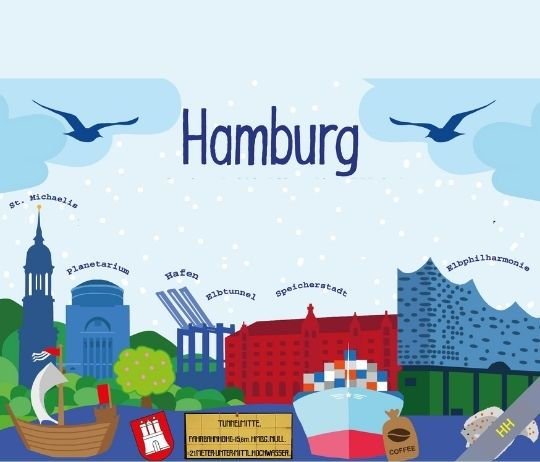
Elbphilharmonie is an architectural chord on the banks of the Elbe: a sparkling façade like waves of light and halls with acoustics designed for passion and silence. This is not just a concert hall, but a symbol of a modern city where classical music meets the breeze of the port, inviting you to listen to the world.
In the unique floating warehouse district of Speicherstadt, 19th-century brick facades line the canals. This UNESCO World Heritage site resembles a living museum of urban commerce: the history of logistics meets contemporary art, and the labyrinth of bridges and docks inspires strolls and exploration.
HAMBURG: COAT OF ARMS' THE HISTORY
The fortress gates on the coat of arms symbolize the independence of the free city.

Hamburg grew not around a palace or by the will of a monarch, but out of practical necessity — trade, defense, and negotiation. From the very beginning, the city by the water saw itself as a port, a crossroads of paths and characters.
Here, people early learned to value freedom, consider profit, and respect rules — primarily their own. Merchants, guilds, and ships shaped Hamburg as a place where status was determined by deeds, not by birth. This habit of living "by contract" is still evident in its appearance and character.

The coat of arms of Hamburg depicts a white castle with three towers on a red background. The castle symbolizes the city's cathedral, St. Mary's, and the stars highlight her as the city's patron saint.
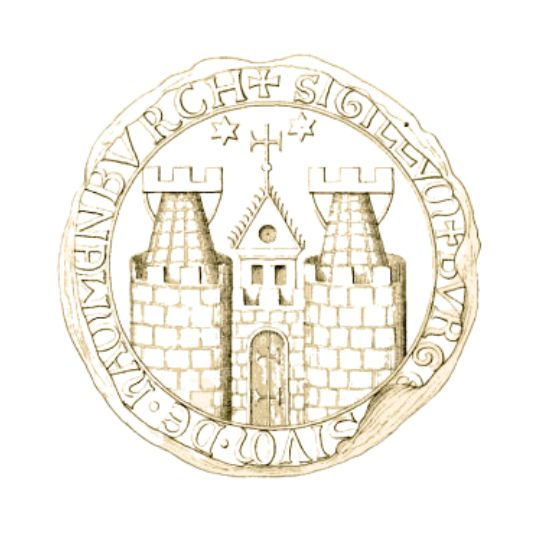
One of the early city seals from 1241 depicts Hamburg as a fortress with three towers, the central one connected to St. Mary's Church — the city's main spiritual landmark. The temple emphasized that this was not just a trading post, but a Christian community protected by heaven and walls. The architecture here speaks a language of symbols — the city stands as long as faith and order stand.

Sometimes, the Holstein nettle leaf appears on Hamburg coats of arms — a symbol of the neighboring region and a reminder of the complex relationship with Denmark. This isn't botanical, but political: for centuries, Hamburg balanced between formal dependence and genuine independence. The nettle leaf is a symbol of the Danish crown's influence and, at the same time, a jab in the eye: the city accepted the signs of authority, but retained its own character and habit of living by its own rules.
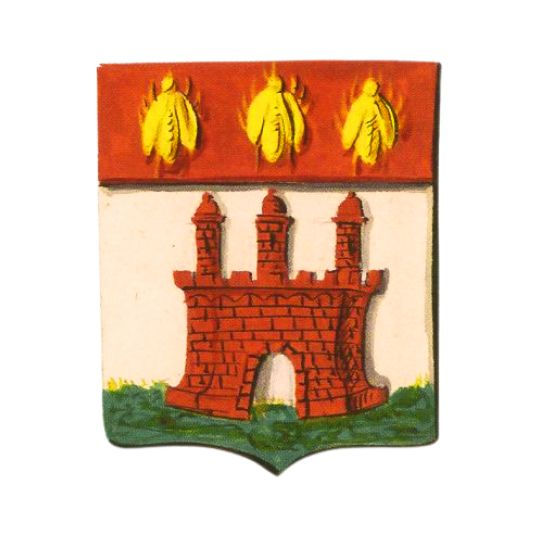
The Napoleonic era briefly deprived Hamburg of its beloved independence. The city became part of the French imperial system, and the coat of arms became more "official" and imperial in spirit. Golden bees on red were added as a symbol of a first-tier city in the new hierarchy, but to achieve this, the historical colors were inverted — the result was a red castle on a silver shield. After Napoleon's departure, Hamburg quickly regained its familiar appearance and old symbols.
Modern Hamburg consists of seven districts, each quite distinct from the other. Those who enjoy fun and celebration should take time to visit the St. Pauli district, home to the so-called "Vicious Mile," today a trendy nightlife hub with the most popular bars and cabarets. And, of course, the Reeperbahn, the main street of the bustling red light district. Tourists from all over the world come here to enjoy themselves. Or at least to watch.

The main intrigue of the Hamburg coat of arms is the gate. Throughout history, they have been alternately closed and open, and this is not an artistic whim. Closed gates signify sovereignty and a willingness to defend oneself, while open gates signify trade, hospitality, and self-confidence. Hamburg has always been able to combine both.
Hamburg's city gates are closed today, but the coat of arms of the Altona district depicts them open. Altona has long been "the other Hamburg": freer, less formal, with its own history. Today, it is one of the city's most vibrant districts — a place where the idea of an open port has become a way of life.
HAMBURG: FUN FACTS
Of the Hanseatic treaties and hit guitar riffs.
A few words about the status of Hamburg and why it is called the "Free and Hanseatic City of Hamburg." To do this, let's turn to the history of the Hanseatic League – a major trading alliance of free cities in Northern and Western Europe that emerged in the 13th century.

It all began in 1241 with the formation of the "Union of the German Cities of Lübeck and Hamburg," which, through successful wars in the Baltic Sea with the Danish and Swedish kings, soon developed into the vast Hanseatic League. Two hundred years later, it united 160 cities with the goal of providing members with trade privileges. The Hanseatic League's active activities and independent foreign policy over the course of 400 years are considered one of the first examples of globalization.

Hamburg was one of those cities that not only belonged to the Hanseatic League, but actually lived by its charter. It proved to be a near-perfect hub within this system: access to the sea via the Elbe, a merchant character, and an innate dislike of excessive centralization. Here, agreements were reached faster than orders were given, and reputation was valued as much as gold. It was the Hanseatic experience that taught the city that freedom and order coexist perfectly when bound by contract.

Before worldwide fame, stadiums, and hysterical fans, the Beatles had Hamburg, nightclubs, and hours-long concerts. It was here, in the St. Pauli district, that the young musicians honed their sound, character, and stamina — playing for six to eight hours straight.
Hamburg made them louder, tougher, and more confident. A noisy, straightforward port city, it didn't require genius — it required energy, and the Beatles provided it. The musicians later admitted that without Hamburg, Liverpool as we know it wouldn't exist. So, rightfully so, guitars and amplifiers stand alongside merchants and ships in the city's history.


Comments