THURINGIA
- Mar 24
- 5 min read


Thuringia is the "Green Heart of Germany"... Art lovers and romantics alike are simply obliged to visit the place where world-changing creative ideas were born.
THURINGIA: ICONIC LANDMARKS
Forests, castles and cities like Weimar create a cozy historical landscape.

Thuringia (Thüringen) is a state in the center of the country, sometimes called the "Green Heart of Germany." It also has an official name: the Free State of Thuringia. Sounds good!
The calling card of Thuringia is, above all, Weimar. This is not just a city, but a pilgrimage destination for lovers of literature, history, and art, where you can experience the legacy of the great classics of German culture: the house museums of Johann Goethe, Friedrich Schiller, and Franz Liszt, the church where Johann Sebastian Bach played...
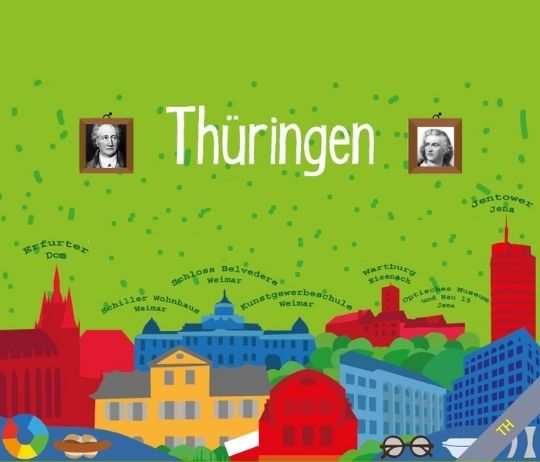
Weimar is a city you can explore for hours. It will not only tell you about the past but also give you a sense of how great ideas become eternal.
The capital of Thuringia, Erfurt, is renowned for its beautifully preserved medieval center, the unique Shopkeepers' Bridge, and its majestic cathedral. Thanks to its success in floriculture and the creation of wonderful parks, it has long been known as the "city of flowers."
But outdoor enthusiasts won't be bored either – the mountains of the Thuringian Forest provide the backdrop for Germany's most beautiful hiking trail, the Rennsteig, which is 169 km long.
THURINGIA: COAT OF ARMS' HISTORY
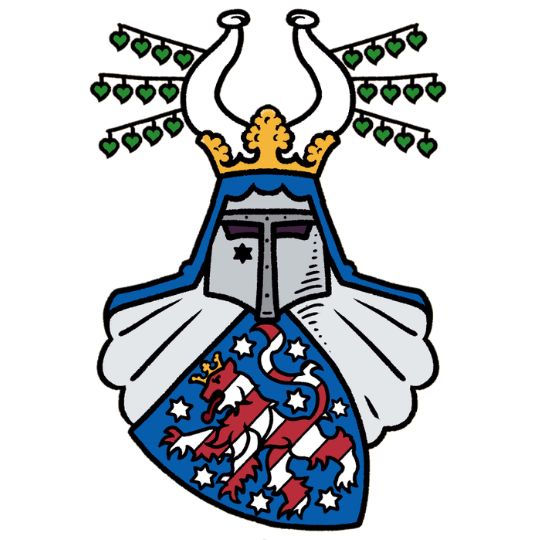
The striped lion with stars reflects ancient Thuringian heraldry.
Thuringia has long been a convergence of trade routes, the birthplace of principalities, and the birthplace of ideas that transformed the country from within. A land of castles and forests, Thuringia has long been a crossroads of power, culture, and faith, where history was written quietly but steadily.

The oldest surviving color depiction of the original Thuringian coat of arms is that of Count Conrad of the Ludovingian line, who lived in the 13th century.
The Ludovingian Counts of Thuringia were among the secular princes of the Holy Roman Empire during the High Middle Ages. At the beginning of the decline of imperial power, they ensured political stability in the region by forcing the Thuringian nobility to acknowledge their feudal dependence.

The origin of this unique lion coloring is unknown. There are many theories, but we'll accept the simplest one: Count Konrad count just liked it.
Another theory, more a historical one, suggests a likely fusion of two coats of arms. In our case, it's an ancient symbol of power, a lion, with a "belted shield." There was no single, established rule, so variations were possible. The various final results of such a fusion can be traced in the coats of arms of Limburg in Belgium, Luxembourg, and Thuringia.

It's worth noting that such a bold color combination sparked imaginations far beyond Thuringia, especially among spirited southern artists — as is clearly demonstrated by the interpretation of the coat of arms by a 16th-century Spanish herald, where the severity of the Germanic symbol unexpectedly transforms into something almost decorative.

Despite its long history, Thuringia as a single entity first appeared on the map of Germany in 1920 as a result of the unification of seven previously independent German principalities: Saxe-Weimar-Eisenach, Saxe-Meiningen, Saxe-Altenburg, Schwarzburg-Rudolstadt, Schwarzburg-Sondershausen, Saxe-Coburg and Gotha, Reuss of both senior and junior lines... phew, calculation complete!

If, when choosing a new joint coat of arms, they had simply combined the coats of arms of all seven principalities, the result would certainly have been garish and unreadable. Therefore, a decision was made to simplify and depict everything as seven stars. However, why limit ourselves? With a little imagination, one can imagine what a coat of arms of Thuringia composed of seven coats of arms would look like. Yes, it's overloaded, but at least it offers ample opportunity to examine and ponder.

Starting in 1933, the stars suddenly disappeared: most likely, their shape was deemed politically unreliable. Instead, the Thuringian lion obediently and loyally holds the symbol of the Third Reich in its paw. Since the coat of arms also depicted the eagle, the lion, and the hen, along with the Saxon wreath, the new coat of arms soon earned the nickname "Thuringia Zoo."

Political loyalties are always polarized, so after 1945, the radical red color was quickly restored to the coat of arms, the crown was removed, and a star was added. The new eighth star symbolized the former Prussian territories (primarily Erfurt and its surroundings), which were not yet part of Thuringia in 1920. With the replacement of the GDR states with districts, this coat of arms also lost its relevance in 1952.
The current coat of arms was adopted in 1991. To everyone's satisfaction, everything finally fell into place: the lion, the colors, the crown, and the stars.
THURINGIA: FUN FACTS
Of a music of heaven, the secret influence of coats of arms, and very earthly joys.

Johann Sebastian Bach seems a timeless figure — too perfect to belong to one place. And yet, his story begins quite concretely: in Eisenach, a city in Thuringia, where music was part of everyday life, not just church rites. Bach was born into a family of musicians, and his ear developed early, not in the quiet of his study, but amid bells, chorales, and the sounds of the streets.
The coat of arms of Eisenach depicts Saint George, a warrior and patron saint who slew a dragon. It's tempting to assume that he was the future maestro's first, albeit symbolic, listener. Perhaps this is where Bach's music derives its astonishing combination of discipline and inspiration, earthly toil and almost heavenly clarity. His symphonies don't strive to impress — they establish an order in which even struggle resounds as harmony. And in this sense, Thuringia truly gave the world not just a composer, but an architecture of sound.

From the heavenly to the earthly, and again without dissonance. After Eisenach, Bach's itinerary quite logically led to Mühlhausen, where he served for several years as organist at St. Mary's Church. The music there sounded strict, Lutheran-style, and Bach himself was particularly demanding at this time — of the congregation, the choir, and of himself.
But Mühlhausen knows how to remind us: the spiritual does not negate the physical. Today, the city is also famous for being home to Germany's first museum of fried sausages. Yes, those legendary ones. The exhibition is comprehensive, covering history, philosophy, and, of course, aroma.

And there's not a hint of blasphemy in this. Thuringia masterfully combines the sublime and the simple: fugue and minced meat, chorale and grill. Perhaps this is why Bach's music is so compelling — it appreciates the sublime, yet keeps its feet firmly on the ground.
Having sated ourselves spiritually and physically, we can move on to a mental exercise. At first glance, the coat of arms of Thuringia is indistinguishable from the coat of arms of the state of Hessen. But a closer comparison reveals four significant differences. Hint: in addition to the obvious crown and stars, pay attention to the number and order of the stripes. The tail doesn't count.


Comments