BURGENLAND
- Mar 26
- 4 min read
Updated: Mar 31

Burgenland is the sunny side of Austria, with vineyards, steppe lakes and a mild Pannonian climate, where borders blur and the atmosphere becomes almost Mediterranean, but with Austrian precision.
BURGENLAND: ICONIC LANDMARKS
Everything here breathes the south: Lake Neusiedl, wine villages and long sunsets that seem in no hurry to go away.

Burgenland, the easternmost, least populated and youngest of the federal states.Until then, the border area between Austria and Hungary had a turbulent past, regardless of the presence or absence of these borders. The name speaks for itself: Burgenland – "Land of Castles". Many are quite picturesquely preserved.

Esterházy Castle is one of Burgenland's most famous historical landmarks. The castle was the residence of the Esterházy dynasty and is now open to the public, offering spectacular tours of its beautiful halls and gardens.
Burgenland is known and celebrated as a wine region . It's a place where wine connoisseurs can visit numerous wineries and sample the best local wines while enjoying magnificent views of the vineyards.
Lake Neusiedl is the fourth largest lake in Central Europe, Europe's westernmost flat salt lake, a popular recreation area, and a biosphere reserve. This area is attractive for its natural beauty and numerous birdwatching spots.
BURGENLAND: COAT OF ARMS' HISTORY
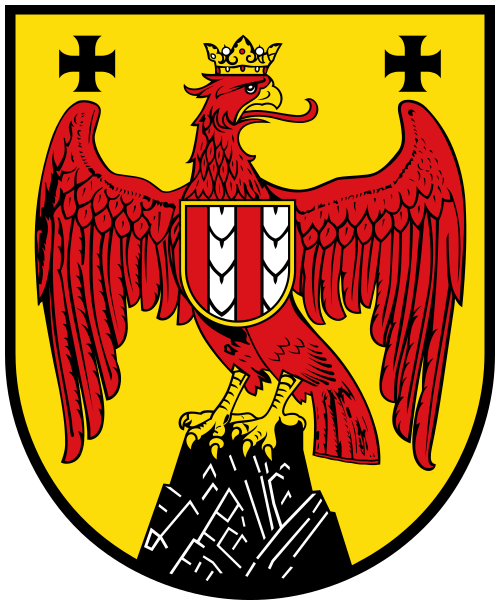
The coat of arms of Burgenland is a careful compromise of regions, where each symbol seems to negotiate with its neighbors.

For a long time, these were Hungary's western marches — a strip of castles that protected the country from imperial troops and raiders from the west. Local settlements thrived on a mixture of languages and traditions, and aristocratic families built fortress after fortress here. Burgenland remained a borderland for centuries — harsh, changeable, but vibrant. Only after the First World War did it become part of Austria, retaining its distinctive, slightly Hungarian atmosphere.

The Burgenland coat of arms is an example of a common diplomatic compromise in the world of heraldry. It combines the symbols of two influential medieval families that controlled these lands long before someone thought of calling them "Burgenland."
Although, in fact, it's well known who came up with the name — in 1919, it was Odo Röthig, who moved to these parts from Vienna. True, the name was originally "Vierburgenland" ("Land of Four Castles"). It was derived from the names of four Hungarian vármédye ("counties"): Pozsony, Moson, Sopron, and Vas. However, after Pozsony became part of the Czech Republic, the connection to unstable numerals was removed. The result was the universal "Burgenland" ("Land of Castles").

At the modern coat of arms of Burgenland, on one side are the Counts of Mattersdorf-Forchtenstein (in Hungarian, Nagymárton and Fraknó). Their symbol is a proud eagle, standing confidently on a rock, as if on personal principles.

On the other hand, the no less resonant von Güssing-Bernstein (also known as Németújvár in Hungarian) owns a red and white shield — simple yet proud, as befits an ancient family accustomed to the vicissitudes of history.
If you managed to read all these surnames and place names without hesitation, congratulations: you are either a natural-born philologist or secretly studied Hungarian.

As for the "influence" of the aforementioned families, history, alas, is slow to confirm it. Perhaps one family allegedly originated in northern Spain, while another featured a certain count Iban von Bernstein, also known by his birth name János Kőszegi. He was, to put it mildly, a peculiar individual — even by mid-century standards. So much so that he earned the nickname "Wolf" ("Farkas" in Hungarian). No images of him have survived, but it's safe to assume he bore a resemblance to his contemporary and idol, Vlad Tepes, who also had the nickname "Dragon" ("Dracula" in Romanian).

The first attempts to create a coat of arms for the new federal state were made in 1919. The designs included the innovative idea of playing on the state's name with the image of a crenellated roof and a castle, taken from the coat of arms of the city of Sopron. Sopron (Ödenburg in German) was intended to be the future capital. However, the ungrateful Sopron voted to remain part of Hungary, and its castle obviously could no longer be part of the new coat of arms.
The final, modern design was approved in 1922, although legal issues regarding its description and use were only properly resolved in the 1990s.
BURGENLAND: FUN FACTS
Of the importance of proportions in any matter and the dependence of the direction of view on the point of view.

A curious detail: most heraldic animals face right (in the sense of "heraldic right," meaning to the viewer's left). But the Burgenland eagle is pointedly turned left, as if casting a curious glance across the border toward Hungary. Perhaps it's nostalgia.
The eagle itself slightly violates classical heraldic canons: it's overly decorative, with a hint of Baroque theatricality. But it's striking, especially when compared to its much more modest relative — the eagle on the coat of arms of the regional capital, Eisenstadt. That looks as if it still hasn't recovered from the Hungarian reforms and taxes.
So, if you come across this proud Burgenland coat of arms on your next trip to Austria, know that you are looking at a symbol of a region where even eagles know how to diplomatically look in the right direction.


Comments