GRAUBUNDEN
- Apr 2
- 6 min read
Updated: Apr 9


Graubunden is the largest canton in Switzerland, so it has a lot to offer: three languages, Alpine valleys, and some of Europe's most scenic railways, which are considered engineering marvels.
GRAUBUNDEN: ICONIC LANDMARKS
Here you will find Davos, St. Moritz and some of the most beautiful mountain valleys in Europe.

Graubunden , or Grisons , is the largest canton of Switzerland, located in the southeast of the country. Its capital, Chur, is considered one of the oldest towns in the Alps, and the canton itself is known for its rare linguistic diversity: alongside German, Romansh is spoken here — the country's fourth national language.
The canton's greatest engineering marvel is the Albula–Bernina railway , connecting Chur with the southern valleys. The train traverses viaducts, tunnels, and high mountain passes, gradually changing the landscape from pine forests to rugged rocky slopes. This route is a UNESCO World Heritage Site and has long been a symbol of Swiss precision applied to the complex Alpine geography.

The Engadine, a long, high-altitude valley with rare, transparent light and a sharply defined landscape, sets a special mood. Here, villages appear carved from stone and sun, and houses are decorated with sgraffito — traditional stucco ornaments. Lakes stretch in a chain along the valley, reflecting glaciers and dry slopes, creating a sense of space not typically expected among the Alps.
The connection between ancient and modern is particularly noticeable in the area around Chur: Roman roads stand side by side with modern tunnels, and the old town's narrow streets unexpectedly open up to the railway lines leading through the passes into Italy. Graubünden feels more like a network of valleys than a single region — and that's why a journey here always feels like a series of discoveries.
GRAUBUNDEN: COAT OF ARMS' HISTORY
The coat of arms unites the three ancient unions from which the canton arose.

The canton of Graubunden is perhaps the most philosophical in Switzerland.

Its history begins not with a king or a battle, but with a treaty. In the 15th century, three alliances of free communities and small estates united in the Alpine valleys. Not for glory, but for survival, order, and independence. Their coats of arms later formed a single symbol for the canton.

The first was the Union of God's House (Gotteshausbund), founded in 1367. The name sounds pious, but the motive was quite mundane: local communities were tired of the rule of the prince-bishops of Chur, who managed their lands as private estates, and they limited their authority. The union united valleys, towns, and monasteries around the idea of collective self-government.
The goat on the coat of arms seems somewhat at odds with the union's name, but let's assume it symbolized the rugged Alpine fortitude and independence. It's not the devil, but a local: stubborn, resilient, and perfectly navigating the slopes of power.

The Grey Union (Graubund) emerged around 1395 and was perhaps the most "Alpine" in spirit. Its name derives not from despondency, but from the gray homespun cloaks of the peasants and community members. It was an alliance of people without grand titles, but with a clear understanding: it is better to agree among themselves than to wait for someone from above to do so.
The Gray Union united mountain valleys where power was traditionally a matter of assemblies, not thrones. Equality and collective responsibility were especially valued here. Their coat of arms is a minimum of imagery and a maximum of meaning: order, agreement, and cold clarity. From a coloristic perspective, it can be added that the coat of arms encodes the union's name: "black plus white equals gray. "

The third union emerged in 1436 after the demise of a noble dynasty of local rulers. The vacated power base did not remain empty: ten judicial districts decided to govern themselves independently. Thus emerged the Ten Courts' Union (Zehngerichtenbund) — the most legalistic of all.

Here, law, not origin, was at the center. "Court," "contract," "procedure "—words that sounded surprisingly modern in the Alps. The union's coat of arms was simple and austere, like the minutes of a meeting. The presence of a cross suggested that judgment would be according to God's laws (though this is not certain). This union became the foundation of the future cantonal tradition of Graubünden — respect for the rules, even when all around are mountains and fog.
Even after the three unions legally and de facto became a single canton, they couldn't immediately agree on how to combine the three symbols on a single coat of arms . Therefore, for a long time, they simply depicted the three coats of arms side by side. Only in 1932 did the three finally approve a single cantonal coat of arms.
GRAUBUNDEN: FUN FACTS
Of the saving on creativity and mystical transformations.

Each of the three unions had its own patron, who also served as the bearer of the coat of arms: the Holy Virgin Mary, Saint George, and a giant or, perhaps, a savage. A 17th-century artist quite creatively depicted all three patrons in a "three-in-one" style, holding the combined cantonal coat of arms. Perhaps the rascal skimped on colors and the size of the work, but at least it was unconventional.

Another amusing observation: if you imagine the Graubünden coat of arms in a black-and-white noir movie, a completely different, unusual feeling emerges: stern faces, candlelit vows, mountain passes like scenes from a mystical thriller. The black ibex is no longer simply a symbol of fortitude, but almost an Alpine evil spirit, watching over the observance of treaties. In Graubünden, even mysticism is disciplined.
GRAUBUNDEN: ALPINE SKIING
The vast number of resorts makes the region the largest ski centre in Switzerland.

St. Moritz is a true icon of luxury, attracting the world's elite. It boasts a unique "Champagne climate," and the sun shines 322 days a year. But most importantly, it's not just an expensive resort; it's a place where history and modernity intertwine. Here, on the frozen lake, the "White Turf" horse races are held in winter. Here, the philosopher Friedrich Nietzsche summered in the nearby village of Sils-Maria and wrote part of "Thus Spoke Zarathustra."

The Corvatsch-Furtschellas ski area (120 km of slopes), just opposite St. Moritz, offers additional opportunities: the highest point is 3,303 meters, and the Hahnensee piste is considered one of the most beautiful slopes in the Engadine. And for the most daring, the Diavolezza-Lagalb ski area offers take-no-prisoners, only red and black runs for experts, including Switzerland's longest off-piste glacier descent, at 7 km. If you don't mind an adrenaline rush, go for it!

Davos and Klosters are like two brothers, completely different, yet inseparable. Davos is a cool, cosmopolitan city located at the highest altitude in the Alps. It feels more like a mountain capital, with tons of shopping and a vibrant nightlife.

Klosters, however, is its complete opposite: a quiet, charming village where people come to relax and escape prying eyes. It's no wonder that members of the British royal family have chosen Klosters for their winter getaways for decades.
These two resorts are connected by the vast Parsenn ski area, so you can enjoy both in one day. Parsenn is considered the cradle of Swiss skiing, hosting the first cross-country ski race in 1924.

Arosa-Lenzerheide is a true sunny paradise. Situated at the bottom of a wide valley, the resort is one of the sunniest in Switzerland. Free from hustle and bustle, it's the perfect spot for a family vacation and relaxing skiing.
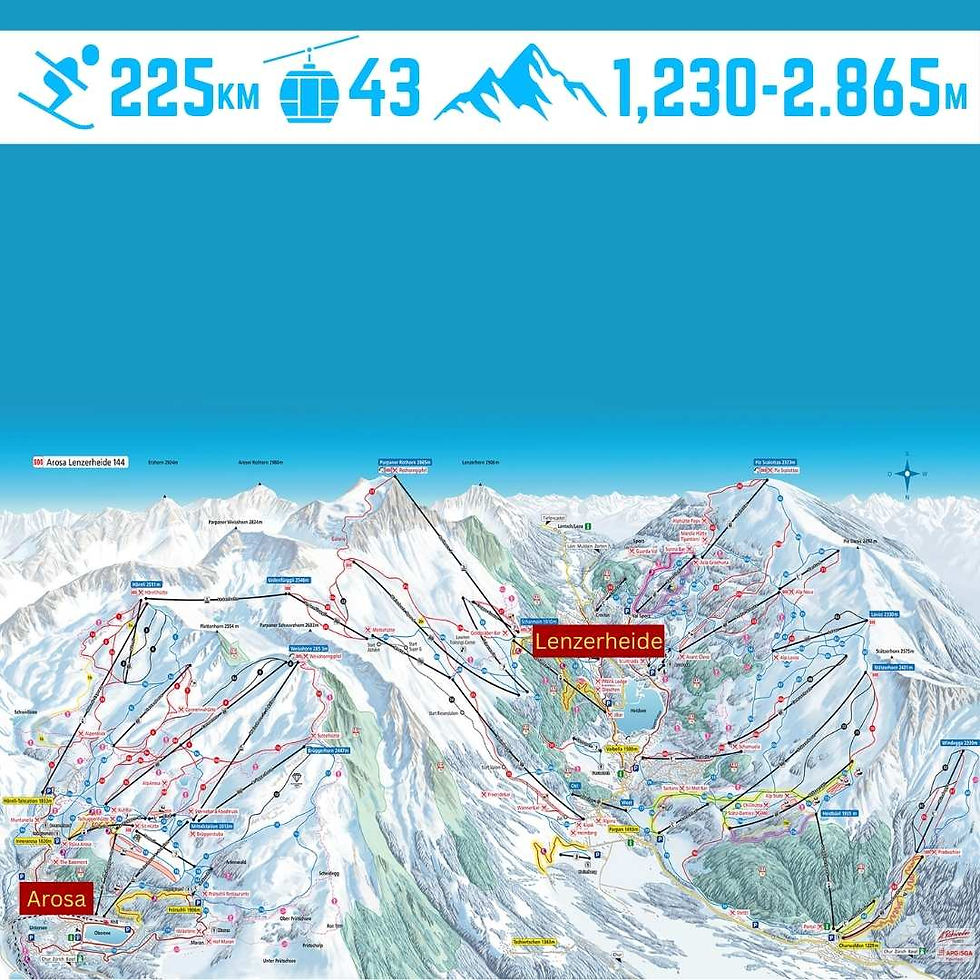
Arosa is also famous for being home to the Arosa Bärenland Bear Park, a unique nature reserve where bears are rescued. So, in addition to skiing, you can observe bears living in their natural habitat. And if you're lucky, you can even compete with them in speed.


Comments