GLARUS
- Apr 2
- 5 min read


Glarus is a Swiss canton that still practices direct democracy: public assemblies with voting, alpine valleys, and a rich industrial history. It also has its own nickname, Ziegerschlitz, referring to the unique terrain and local cheese.
GLARUS: ICONIC LANDMARKS
The narrow valley, surrounded by high mountains, creates one of the most dramatic alpine landscapes.

Glarus is a canton of straight cliffs and even straighter decisions. Here, the mountains seem to be cut with a knife, and democracy is practiced in the open air. It is here that the Landsgemeinde — the people's assembly, where citizens vote by raising their hands — still takes place. No screens, only sky, squares, and responsibility.
The town of Glarus is cozy and reserved, but its tranquility belies a turbulent history. In 1861, a fire destroyed almost everything, and the town had to be rebuilt. That's why the streets here are unusually wide and smooth for an Alpine settlement — a rare case of tragedy giving birth to order.

Nature works on contrasts. Lake Klöntalersee lies between the mountains like a mirror. And Tödi Peak is almost an Alpine pyramid, austere and unadorned. Tectonic power is palpable in these places: the famous Glarn Thrust in the Sardona tectonic region is a rare geological phenomenon where ancient rocks literally lie on top of younger ones. They make it easy to trace the process of mountain formation and the movement of tectonic plates. It amazes even non-geologists.
Glarus is small and quiet. But he's one of those who doesn't raise his voice — because he already knows his worth .
GLARUS: COAT OF ARMS' HISTORY
The coat of arms is associated with the canton's patron saint and recalls the region's religious roots.

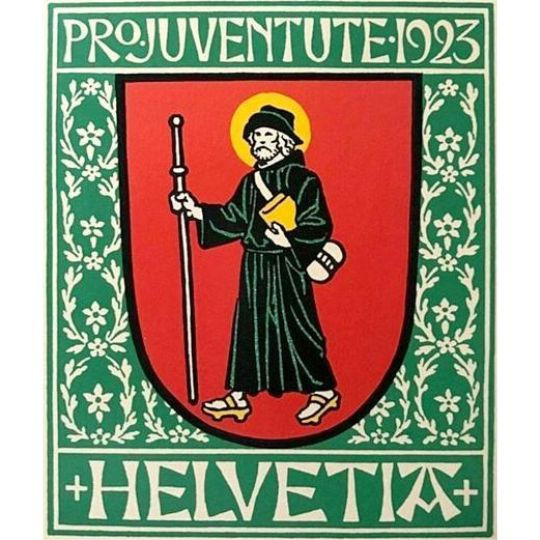
The coat of arms of the canton of Glarus has been known since 1352 and invariably features an image of Saint Fridolin — a figure unusual in Swiss heraldry, but perfectly at home in Glarus itself. Saint Fridolin is depicted in a red field, wearing monastic robes, holding a staff and a book — as befits the founder of the monastery and patron saint of the region.

According to legend, the Irish monk and missionary Fridolin arrived on the continent in the sixth century and settled on a small island on the Rhine. His journey was classic for early Christian wanderings: first a hermit's cell, then preaching, and finally organizing a community. Around 600, Fridolin founded Säckingen Abbey, later one of the most influential monasteries on the Upper Rhine.

It was to this abbey that the German king gifted the Glarus mountain region, and over time, Saint Fridolin became venerated as the region's patron saint. Today, the abbey is located on the border between Germany and Switzerland in the town of Bad Säckingen, which has a distinctive coat of arms.

In 1352, Glarus joined the Swiss Confederation, and the peaceful image of the saint on the coat of arms became synonymous with the harsh realities of Alpine life. Fertile valleys are almost nonexistent here, and many young residents turned to mercenary work — a dangerous but honest and well-paid profession. The canton's residents were saved by discipline, a modest lifestyle, and a tradition of solidarity.
Glarus owes its stellar fame to the famous Battle of Näfels in 1388. Here, the canton's foot militia inflicted a crushing defeat on the Austrian knightly cavalry. This episode went down in history as one of the first clear signs of a new military world: the dense, disciplined formation of infantry was more powerful than the individual brilliance of knights, no matter how strong their armor. However, this historical fact was not reflected in the coat of arms of the municipality of Näfels.
Today, the canton is, without exaggeration, governed by direct democracy in its purest form. The highest authority is the annual Landsgemeinde (People's Assembly). Every year, on the first Sunday in May, residents openly raise their hands in Glarus's main square and decide the most important issues of cantonal life. There are no electronic ballots, no distance between the authorities and the people — only tradition, the Alpine air, and absolute responsibility.
GLARUS: FUN FACTS
Of the rethinking of image in fine art and the color scheme of cheeses.

Over the course of nearly seven centuries, the image of Saint Fridolin on the coat of arms has changed many times. Sometimes he was depicted with a reverent austerity, sometimes with a touch of naivety, sometimes with an almost baroque quality. Each era added its own touches, its own vision of holiness, power, and artistic norms. Therefore, on old seals, Fridolin is one person, on Renaissance flags, a completely different one, and on 19th-century shields, he is quite academic.
The modern alternative coat of arms, designed as a stylized graphic symbol, walks a fine line between classic heraldry, logo minimalism, and a touch of Swiss humor. It almost transforms Fridolin into a pictogram of a holy pedestrian, but thanks to the austere composition, its recognizability is fully preserved. Judging by the boldness of the latest redesign , one can assume the residents of Glarus are ready for another round of experimental thinking. And it looks like there's more to come.

The Glarus region boasts a distinctive landscape, but locals aren't upset by it; they even turn it into a joke: the canton is sometimes called "Ziegerschlitz" — "Zieger Gap." This is because the narrow valley in which the canton is located forms a distinctive "gap" (called "schlitz" in German), and here a unique cheese called Zieger (or Schabziger) — the so-called "green Swiss cheese" — is produced.
GLARUS: ALPINE SKIING
The Glarner Alps offer excellent pistes and routes for freeriding.

Elm is a mountain valley with a true alpine atmosphere. This small resort on the slopes of Sernftal, in the shadow of glaciers, is ideal for family-friendly, relaxing skiing. Elm offers 40 km of perfectly groomed slopes for carving, skiing, and snowboarding. A 4-kilometer toboggan run also offers tons of fun sledding. Children can explore winter sports carefree and playfully on three slopes of varying inclinations in the sunny Empähli children's area , using attractive equipment.

Additionally, various hiking trails wind through the beautiful winter landscape. The slopes aren't particularly long, but they offer several unique views of sheer cliffs, the chilled Glarneralpstock , and a romantic pebbly stream below. A place devoid of crowds, yet filled with the tranquil breath of nature.


Comments