ST. GALLEN
Updated: Sep 11


St. Gallen is a canton of monastic history and universities: a cultural heritage and the famous abbey library, which unexpectedly became one of the centers of European culture.
ST. GALLEN: ICONIC LANDMARKS
The Baroque monastery complex and the famous library are included in the UNESCO list.

The canton of St. Gallen is the eastern showcase of a country where Baroque coexists with textile sophistication, and monastic austerity unexpectedly coexists with lace luxury.
The monastery complex of St. Gallen is more than just architecture; it's a stone-clad argument for cultural continuity. The library is an almost theatrical space: curved balconies, frescoes, warm wood. Here, the manuscripts breathe parchment and time. In the cathedral, Baroque resounds broadly and confidently, like music frozen in stone.

The Old Town is adorned with over a hundred carved bay windows. Camels, lions, and fantastical birds — the facades seem to be participating in a fantasy parade. This is a city that loves detail. The Textile Museum reveals another side of St. Gallen: its fine lace once made it a name on the world market. Even haute couture owes its elegance to it.
From the Drei Weieren (Three Ponds) recreation area, you can clearly see how the city lays out like an amphitheater. St. Gallen doesn't strive to dominate. It prefers to impress with culture.
ST. GALLEN: COAT OF ARMS' HISTORY
The Bear of Saint Gall recalls the legend of the monastery's founding.

Saint Gall — or Gallus of Hibernia — was a 7th-century Irish monk, itinerant preacher, and one of the greatest missionaries of early Europe. He is considered one of the "Apostles of Switzerland."

Where his cell once stood, first a monastery grew up, and then the city and canton of St. Gallen , bearing the name of this stubborn Irishman who went “to carry the word” into the depths of the Alemannic forests.
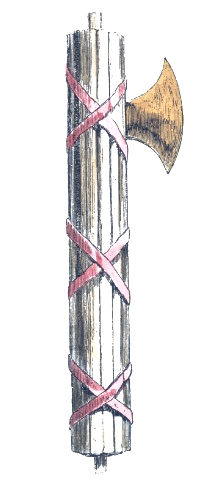
The canton's current coat of arms was approved on April 5, 1803. A silver axe, inserted into a bundle of rods — a lictor's bundle — is depicted vertically on a green field.
In ancient Rome, such a bundle of fascines, bound with leather straps, symbolized a magistrate's right to enforce his decisions by force and punish disobedient individuals. The possession of an axe signified an even higher level of authority — the right to execute and pardon.

It's no surprise that the coat of arms of St. Gallen was a direct echo of the Napoleonic era — a time when half of Europe sought to reimagine its own symbols in the spirit of new republican ideals. The lictor's crown and axe reflected precisely this influence: an appeal to ancient Roman tradition through the prism of French revolutionary aesthetics, emphasizing state power, renewal, and the determination of the new cantonal structure.

The previous coat of arms, however, looked much more traditional and at home in this region: a silver field with a bear — a motif familiar and familiar in Swiss heraldry.
This bear didn't disappear without a trace: although the canton changed its symbolism, the animal continued to live on the coat of arms of the city of St. Gallen , as a tribute to the old legend of Saint Gall and his shaggy companion, and also as a reminder of the region's more ancient and gentle visual heritage.
ST. GALLEN: FUN FACTS
Of the nuances of domesticating wild animals.

According to an ancient legend, when Gallus began building his oratory, a bear came to him one night — noisy, irritated, and perhaps a little hungry. However, the monk was undeterred: he removed a thorn from the bear's paw and calmly ordered the animal to fetch wood for the fire. The bear complied. In exchange for his work, he received bread, accompanied the saint on his travels, and seemed quite content with his new position.
This touching story of holiness, common sense, and good manners was so beloved that the bear of St. Gall appeared on the coats of arms of several European cities, as well as on souvenirs, signs, and even local bakeries. The legend lives on.
ST. GALLEN: ALPINE SKIING
The mountainous areas of Toggenburg are famous for their ski resorts.

Flumserberg is the largest ski resort in Eastern Switzerland , conveniently located between Zurich and Liechtenstein. Over 65 km of groomed pistes, a modern lift system, and a variety of difficulty levels make it attractive to both beginners and experienced riders.

The resort is renowned for its open views of Lake Walensee , one of Switzerland's largest inland lakes, freeriding opportunities, and well-developed infrastructure for family holidays. Ski schools, cozy restaurants, and aperitif areas on sunny terraces create an atmosphere where relaxation is just as important as sport.


Comments