NORTH BRABANT
Updated: Sep 7


The province of North Brabant is a place where design meets fairy tale, Vincent van Gogh is integrated into everyday life, and the boundaries between countries and eras behave strangely to the point of bizarreness.

NORTH BRABANT: ICONIC LANDMARKS
A region where you can travel from fairy tale to industrial design in a single day, and not even feel the transition, or even be a little disappointed by its absence.

North Brabant is located in the heart of Europe and the center of the Benelux region. This can be experienced and enjoyed at any time of year and on any occasion. North Brabant thrives on contrasts, but does so without overexertion.
You can start your morning at Efteling: one of Europe's most powerful theme parks, where fairy tales don't just illustrate but literally shape the space. Everything here is thought out down to the last detail — from the sound of footsteps to the geometry of the forest.
Then comes a change of scenery. Beekse Bergen Safari Park invites you not to look at animals, but to live alongside them. Lions, giraffes, open spaces — and the feeling that you're not a spectator, but a temporary participant.
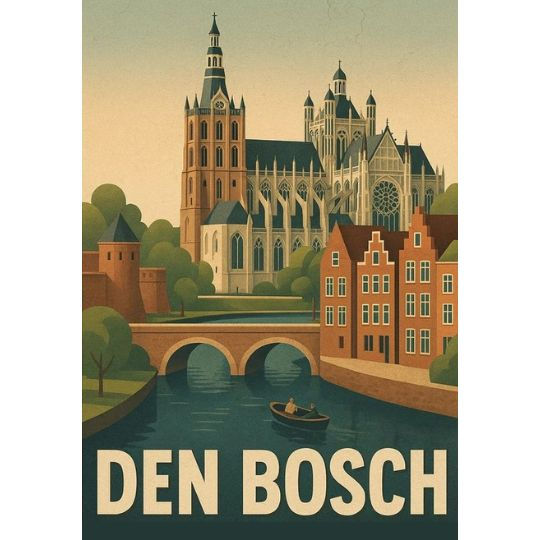
The cultural thread runs through Vincent van Gogh. His route is not a museum exhibition, but a geography of his life: Zundert, Nuenen, Etten-Leur. The landscapes here are not "like in paintings," but the very ones from which the paintings grew.
In Eindhoven, the rhythm changes: the former industrial center has become a playground for design and experimentation. And in Baarle-Nassau, the border with Belgium runs as if drawn without a ruler — through houses, cafes, and habits.
And that is perhaps the best way to describe Brabant: there is logic, but it does not always have to be straightforward.
NORTH BRABANT: COAT OF ARMS' HISTORY
How one lion survived empires, revolutions, and borders — and, it seems, didn’t change much visually, but internally, of course, he grew beyond himself.

North Brabant is a modern Dutch province, but its symbolism is rooted in medieval political geography, where borders changed faster than coats of arms.
The region formed as part of Lower Lorraine, then became the core of the Duchy of Brabant, one of the key centers of power in the historical Netherlands.
After partitions, wars, and administrative reforms, part of the country found itself within the Netherlands, yet retaining the most important thing: a visual memory of its past. In this sense, the coat of arms here is not a decoration, but a stubborn archive.

The history of Brabant begins not with a coat of arms, but with a title. In 1101, the territory passed to Henry of Limburg, but by 1106 it was acquired by Godfrey the Bearded, Count of Leuven — the figure with whom the "Brabant line" is usually counted.
His successor, Henry I of Leuven, secured the title of Duke of Brabant at the end of the 12th century, and with the title came the formalization of the symbol — the lion.

The first mentions of the lion appear on coins and standards, which is important: the symbol immediately functions as a public sign of power, not just a decorative detail. The colors were fixed a little later, in the 13th century: a gold lion on a black field. The choice was quite predictable by the standards of the era: the lion as a universal marker of power, but with local specifics — it was this lion that became "theirs" for the region.
Curiously, during the era of dynastic marriages, the coat of arms regularly acquired new elements — the lions of Limburg, Luxembourg, and other possessions. But the Brabant lion doesn't disappear or dissolve. Rather, it patiently waits for the political fashion to pass .
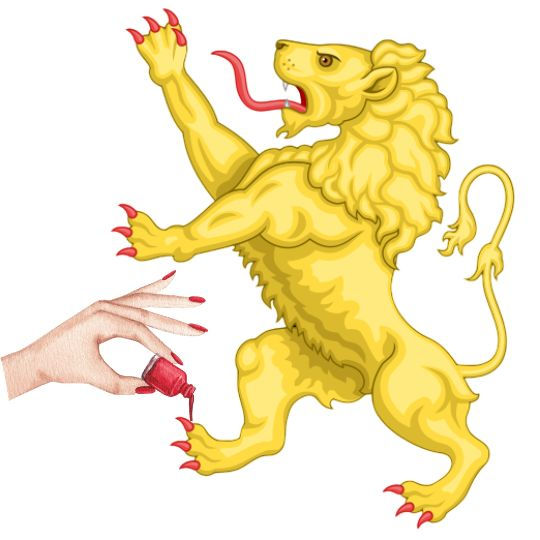
By the 14th century, the lion received an important refinement: red claws and tongue — the so-called "armament." This was not a decorative detail, but a way to enhance the figure's expressiveness and emphasize aggression, readiness to defend and, if necessary, attack. Thus, the classic formula emerged: a golden lion with red arms on a black field — one of the most recognizable heraldic images of the region.
This lion would later become known as Leo Belgicus — the "Belgian Lion," although its geographic ambitions were initially broader. The irony is that a symbol created to demonstrate the power of a specific duchy would eventually come to represent entire countries. Leo, apparently, didn't mind.

From the 13th century onward, Brabant became one of the leading centers of power in the Netherlands. Following the victory at the Battle of Worringen, Limburg was annexed, a significant strategic acquisition. In 1356, the duchy received a charter of liberties, strengthening the position of the cities and establishing an early model of municipal self-government.
The 15th century brought a change of dynasties: Brabant passed to Burgundy, then to the Habsburgs. This meant its inclusion in larger political structures, but the region retained its economic and cultural significance. The University of Leuven, founded in 1425, became an intellectual hub.

In the 16th and 17th centuries, Brabant found itself embroiled in the Eighty Years' War. The result was a division: the north went to the Republic of the United Provinces, while the south remained under Habsburg rule. By the end of the 18th century, the French occupation finally dissolved the duchy as a political entity. Formally, this was the end of history; in reality, it was simply a change of scenery.
Following the Brabant Revolution of 1790 and the subsequent formation of Belgium in 1831, the Brabant lion assumed a new role — it became the central element of the national coat of arms. This decision seemed almost logical: Brabant was the core of the region's political activity, and its symbol already enjoyed considerable "reputation."
In the Belgian coat of arms, the lion retains its original form but is given a new entourage — a crown, supporters, and the motto "L'union fait la force" — "Unity makes strong." Interestingly, it was through Belgium that the lion was finally established as a pan-European symbol for the region. Although, strictly speaking, it never belonged to just one country.
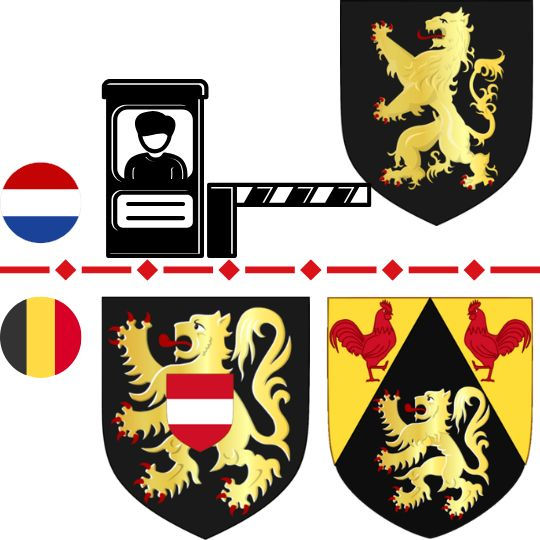
After 1815, the former Duchy of Brabant was divided into parts: North Brabant remained in the Netherlands , and the southern territories in Belgium. In 1995, Belgian Brabant was further divided into Flemish and Walloon Brabant (remember the motto "Unity makes strong").
And here begins an almost heraldic experiment: the same lion exists in several versions simultaneously. In North Brabant, it's the classic version; in Flemish Brabant, it's with the red and white shield of the city of Leuven; in Walloon Brabant, it features Gallic roosters as a regional accent. There are differences, but they're subtle, almost polite. The lion remains recognizable in any version. Perhaps this is its greatest ability — to adapt without changing its essence.
NORTH BRABANT: FUN FACTS
Of the city where Bosch tamed nightmares, and about the city that first gave the world light, and then sound.

The capital of North Brabant, 's-Hertogenbosch, gave the world Jeroen van Aken, better known as Hieronymus Bosch — an artist who makes the term "rich imagination" seem too modest. Born around 1450, he lived and worked in 's-Hertogenbosch, came from a family of painters, and was associated with the Brotherhood of Our Lady.
His paintings are not just hellish visions, strange beasts, and people engaged in dubious activities. They're practically an encyclopedia of human fears, temptations, and weaknesses, painted with such precision as if the artist had seen not sins but their technical drawings. "The Garden of Earthly Delights" still looks contemporary — perhaps because humanity hasn't updated its internal software much in five centuries.

Eindhoven gave the world Philips: the company was founded in 1891 by Frederik and Gerard Philips, beginning with the production of electric lamps. For the city, it became more than just a factory; it was the engine that drove its transformation into a technological hub. As a seasoned music lover, I'll highlight three inventions with almost musical histories: the light bulb in 1892 — for its famous "cozy warm sound," the audio cassette in 1963 , and the compact disc in 1982 , created in collaboration with Sony.
And here the Eindhoven coat of arms fits in beautifully: three horns, as if pre-emptively leaving space for the three eras of sound — light, film, and digital. Historically, of course, this isn't the case. But heraldry sometimes generously tolerates good coincidences.
NORTH BRABANT: LOCAL HERALDRY
About the thorny path of saints to their symbols.

If you place the coats of arms of Putte and Goirle side by side, you get the feeling you're looking not at two municipalities, but at a heraldic puzzle with a theological subtext. In Putte, the headless Saint Dionysius is depicted among armed soldiers; the scene is tense, almost cinematic. In Goirle, the result is already there: the head of John the Baptist on a platter, sternly, without unnecessary commentary.
And although these are two different stories and two separate decisions by local authorities in the early 19th century, they appear almost sequential: first the drama, then the symbol. Heraldry isn't obligated to tell stories linearly, but sometimes it does so with surprising clarity, though the coincidence is almost literary.

The municipality of Best struggled for a long time to decide how exactly to depict its patron saint, Saint Odulf. Initially, in the 19th century, it was simple: the saint in full, with a cross and a blessing gesture. But during an attempt at official approval in the 20th century, the Supreme Council of the Nobility intervened and proposed a radical simplification: leaving not a figure, but a single symbol — an apple. The municipality persisted for nearly a century and a half. Numerous attempts were made — and each time, they were rejected.
It wasn't until 1978 that a compromise was reached: the coat of arms was approved, featuring Saint Odulf, but also an apple and a book. The name "Best" in this story also sounds almost like a commentary — the "best" option, found after lengthy negotiations.


Comments