SOUTH HOLLAND
Updated: Sep 7

South-Holland is a province where old masters stand side by side with futuristic skyscrapers, and between the sea, canals and glass facades, the Netherlands seems to be constantly arguing with itself about its own future.

SOUTH HOLLAND: ICONIC LANDMARKS
A province that simultaneously builds 17th-century museums and space stations.

South Holland has a strange way of creating a feeling: here, the Netherlands looks both authentically ancient and enticingly modern.
One day you can find yourself among the windmills of Kinderdijk , where water has been held back for centuries by a system of canals and pumps, and an hour later you can be looking out over the futuristic skyline of Rotterdam – a city that, after World War II, essentially reinvented itself through architecture, concrete, and audacity.
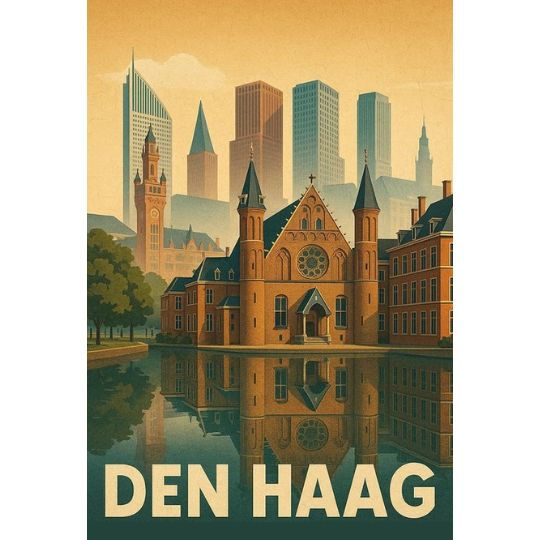
The Hague, however, maintains a completely different tone: diplomatic, almost theatrically restrained. It is home to the Binnenhof castle complex, the international courts, and Madurodam park — a miniature version of the country where the Netherlands looks so neatly assembled, as if it were assembled with tweezers. The irony is that sometimes it's the miniature version that helps us better understand the original.
Southern Holland generally loves to play with scale. Delft boasts quiet canals, Vermeer paintings (his "Little Street" is literally comparable to the original), and famous blue porcelain. In Lisse, Keukenhof Park opens in the spring — a place where tulips look so defiantly perfect you begin to suspect they're the work of graphic designers.
And in between all this — cheese-filled Gouda, the oldest Dutch city, Dordrecht, the beaches of Scheveningen, the North Sea, the glass greenhouses of Westland, and the endless feeling that South Holland has long ceased to be just a province. Rather, it's a blueprint for the future, which for some reason they decided to preserve along with all its historical layers.
SOUTH HOLLAND: COAT OF ARMS' HISTORY
A lion, swamps and very self-confident counts, and why exactly “wooded land” if there are these very swamps all around.
South Holland is the heart of Old Holland in the most literal sense. It was from here that the counts, trading cities, naval power, and the version of the Netherlands that the world later remembered as "Holland" in general arose.
Here are Rotterdam, The Hague, Leiden, Delft – cities where medieval seals, merchant ambitions, and state history are so tightly intertwined that even the modern provincial coat of arms looks not like a decorative symbol, but a brief summary of eight centuries of struggle for power, water, and influence.
The word "Holland" comes from the Old Dutch " Holtlant," meaning "wooded land." It's one of Europe's most ironic place names. Much of early Holland wasn't idyllic oak forests, but damp peat bogs, fog, marshy dunes, and a constant battle with water. Historians speculate that the name referred to the relatively dry forested areas near Leiden— small islands of normal life amidst the vast, humid chaos.
It's very Dutch: there's swamp, wind, and the risk of flooding all around, but you still call the region "wooded land" because it sounds much nicer to future generations and trading partners.
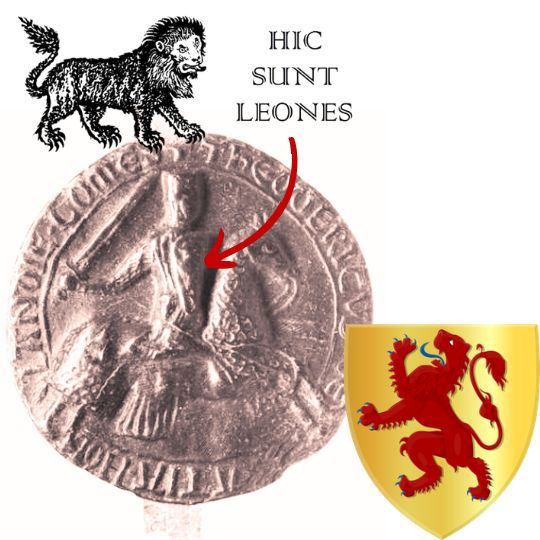
The first reliable depiction of the Dutch lion appears in 1198 on the seal of Count Dirk VII. However, a modern viewer is unlikely to immediately exclaim with confidence, "Why, it's a lion!" Medieval seals generally require a certain amount of imagination, and in some places, an almost archaeological optimism. But the symbol was already important: the lion signified power, a claim to independence, and the right to speak to one's neighbors without unnecessary modesty .
There's a beautiful parallel with the Latin phrase "Hic sunt leones" — "Here are lions." This is how ancient cartographers designated uncharted lands at the edge of the world. And there's something remarkably appropriate about 12th-century Holland: raw territories on the border between sea and land, yet to be literally carved out of nature.
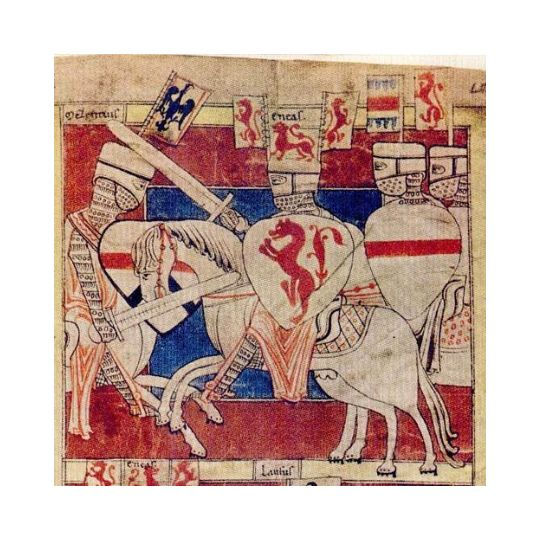
The County of Holland arose from the Frisian borderland within the Holy Roman Empire. The first counts lived among the marshes, built dams, quarreled with the bishops of Utrecht, and gradually expanded their holdings — sometimes through diplomacy, sometimes by force of arms, sometimes through persistent dam-building.
Count Dirk III became particularly famous for his successful rout of the imperial army at Vlaardingen in 1018. For a small marshland county, this was like a fishing village suddenly winning the European Championship. After this, Holland began to be taken noticeably more seriously .
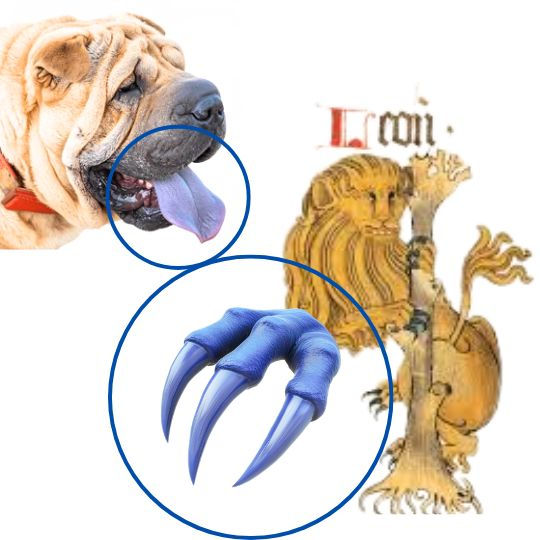
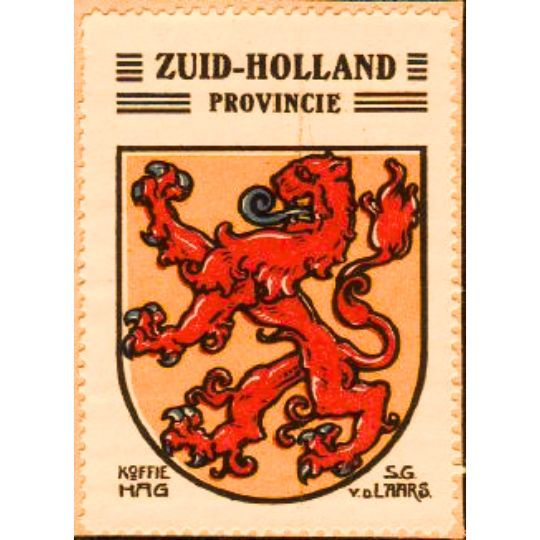
There's no official explanation for the Dutch lion's blue claws and tongue. Heraldry generally likes to leave room for speculation. It's possible that this is simply a way to visually highlight the figure and make the coat of arms more striking .
But I'd like to believe a more poetic version. For example, that the lion lived too long amidst the cold sea wind, storms, and northern dampness. Or that he constantly argued with his neighbors until his tongue literally turned blue from diplomacy. In any case, the combination of red, gold, and blue proved so successful that it has survived time — and that's a serious mark of quality.
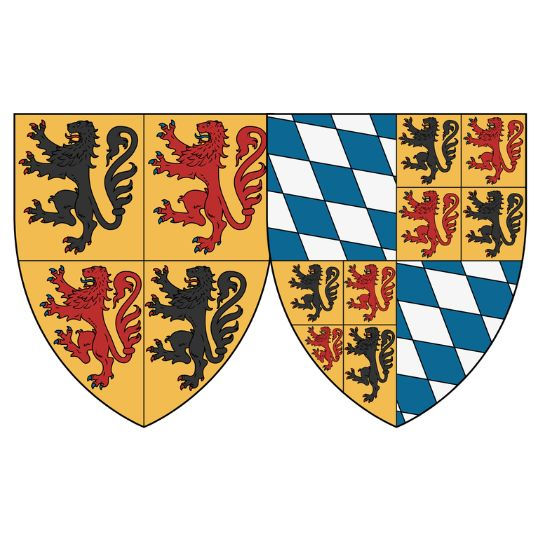
In the 14th century, Holland began to enter into complex dynastic alliances with Hainaut and Bavaria. And then, heraldists seemed to decide to showcase everything at once. The lion of Holland was combined with the lions of Hainaut, the Bavarian diamonds, and other symbols in such rich compositions that some coats of arms began to resemble not a shield, but a family photo album of the European aristocracy.
The Wittelsbachs excelled here: their versions of the coats of arms looked as if someone categorically refused to discard the old elements "because they were also important." In the 15th century, under Philip the Good, this visual noise was gradually abandoned, and the Dutch lion remained alone once again. And, frankly, this was a rare case when minimalism truly won out.
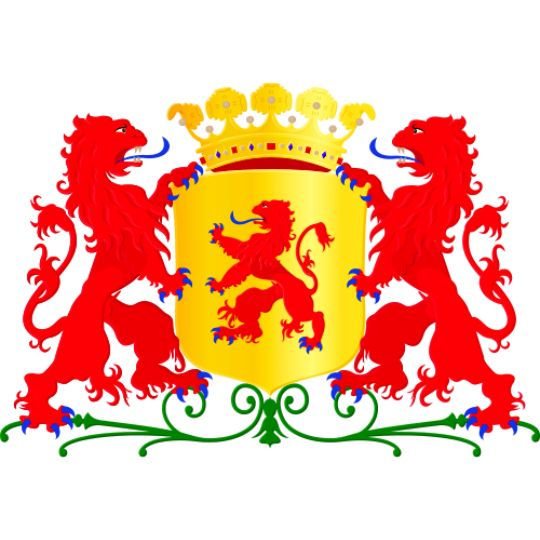
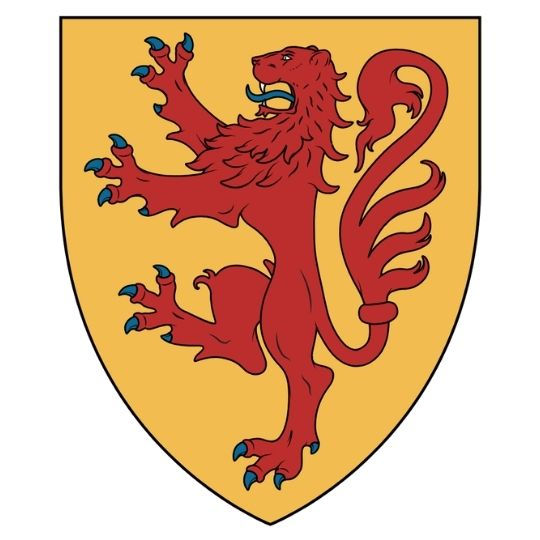
The modern coat of arms of South Holland almost completely retains the medieval image: a golden shield, a red lion with blue claws and tongue, a count's crown, lions supporting the shield and the motto Vigilate Deo Confidentes - "Watch, trusting in God."
It's surprisingly free of decorative flourishes for a region that was for centuries the richest and most influential in the country. Perhaps because the coat of arms no longer needs to prove anything. It has survived counts, Burgundy, the Habsburgs, Spanish rule, the Republic, and the industrial age.
And today, this lion does not look aggressive, but almost calmly confident – like a symbol of a region that once began in the swamps and ended up essentially explaining to the world what the Netherlands is.
SOUTH HOLLAND: FUN FACTS
Of South and North Holland between herring and cheese.
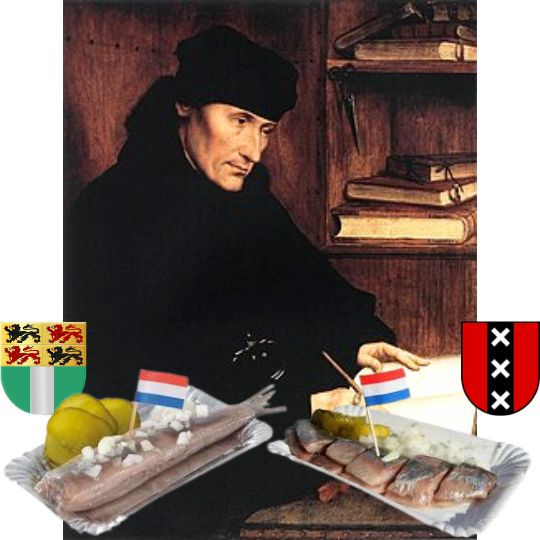
We'll discuss why historical Holland is today divided into North and South Holland separately. But the differences between them exist not only on administrative maps, but sometimes even on the plate. Take, for example, the famous Hollandse Nieuwe — young, lightly salted herring, which the Dutch revere almost as a national treasure .
In North Holland, especially Amsterdam, it's sliced and usually served in a bun with onions and pickles—practical, convenient, and filling. In Rotterdam, the approach is different: the fish is picked up by the tail, the head is thrown back, and it's eaten almost as is, generously sprinkled with onions.
Perhaps the reason lies in the nature of the cities: Amsterdam favors comfort, while Rotterdam favors straightforward conversation without unnecessary embellishment. Legend has it not revealed what Desiderius Erasmus, aka Erasmus of Rotterdam — the great philosopher, humanist, and author of "In Praise of Folly" — thought about this. But had he seen both approaches, he likely would have found them yet another illustration of how humanity is capable of endlessly arguing even about herring.
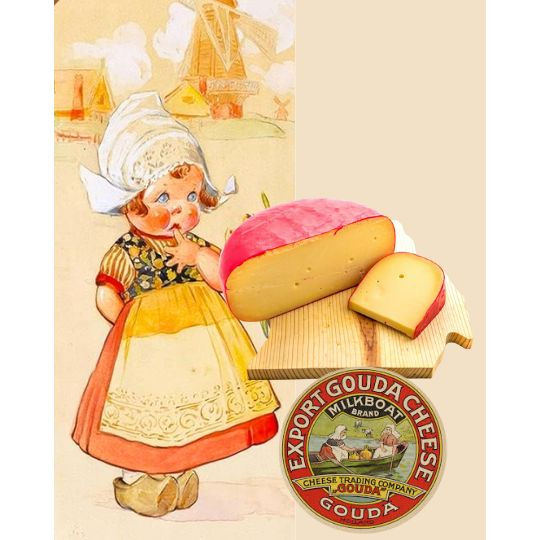
Continuing with the gastronomic theme , we can't forget Gouda cheese — arguably the most famous Dutch cheese in the world. Interestingly, it got its name not because it was produced exclusively in the town of Gouda, but because the largest cheese market was held there for centuries. Farmers would bring wheels of cheese from all over the area, haggle, weigh their goods in the ancient weighing house, and then return home.
Another popular myth concerns the bright red rind. Many consider it an ancient tradition, although in fact, red wax appeared relatively late and was primarily intended for export: it allowed the cheese to last longer and looked more attractive on foreign shelves. True traditional Gouda often had a natural or yellow rind.
It turns out to be a rather Dutch story: the whole world remembers the bright packaging, but the Dutch themselves still value the contents more.
SOUTH HOLLAND: LOCAL HERALDRY
Which sometimes behaves as if it were created by people who read chronicles during the day and fairy tales by the fireplace in the evening.
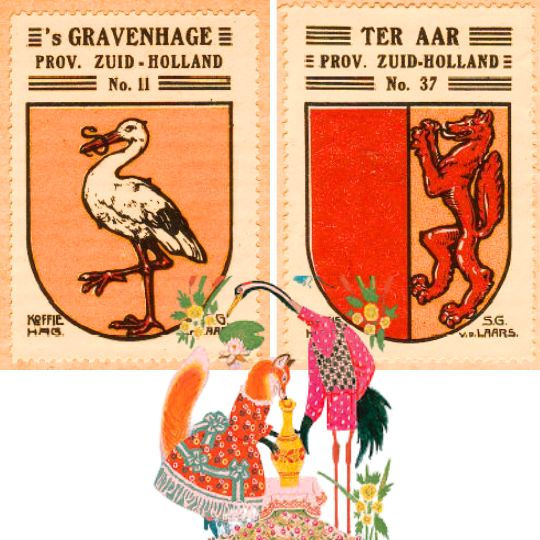
The capital, The Hague , is a city of storks, diplomacy, and perfectly crafted political formulas. Its somewhat unusual coat of arms features a proud stork with an eel in its beak: the bird once helped maintain order at fish markets and was considered a symbol of good luck. The coat of arms of the former municipality of Ter Aar, however, is far more sophisticated — it features a fox on a golden field.
And if you place both coats of arms side by side, you suddenly get a nearly finished illustration of the old fable "The Fox and the Crane." Only in the southern Dutch version, the crane was replaced by a stork — after all, local flavor is more important than literary accuracy. And, like any good fairy tale, the story remains relevant centuries later — especially for people who invite each other for coffee and then spend three hours discussing mortgage rates and bicycle repairs.
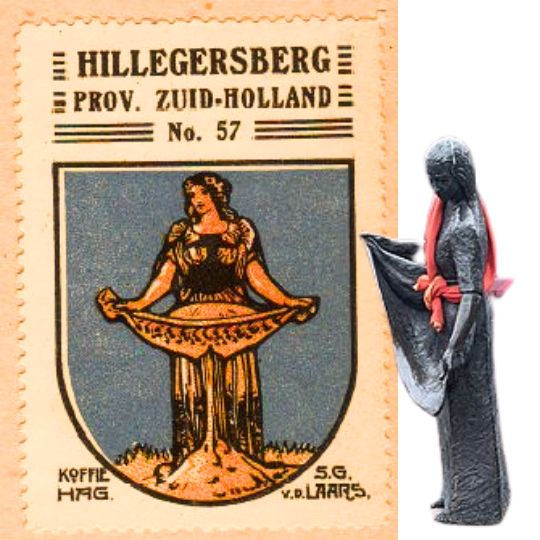
From fairy tale to legend. Hillegersberg, now part of Rotterdam, grew around a sand dune, the origin of which locals explained in the most poetic way possible: the giantess Hillegonda was carrying sand in her apron, the fabric tore, and thus the dune was born. This very moment is depicted on the coat of arms: a giant woman scattering sand from a torn apron. Historians cautiously dismiss it as folklore, while locals call it a beloved legend of the area.
A monument to Hillegonda now stands in the center of Hillegersberg, and the red scarf that periodically appears on the statue has also turned it into a symbol of female solidarity. There's a subtle irony here: once upon a time, a woman accidentally "created the place," and now she serves as a reminder that even legends need human warmth.
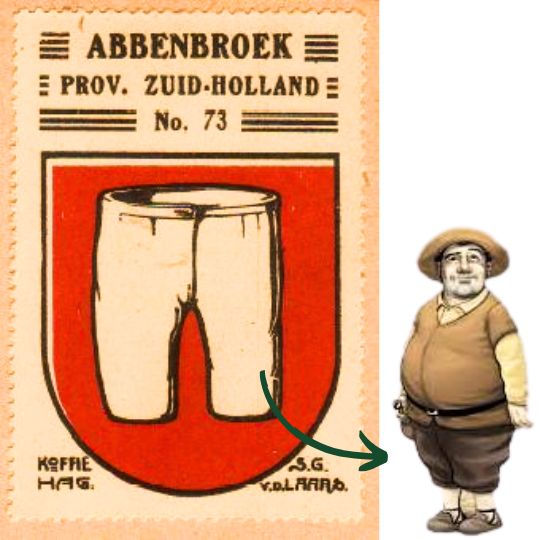
And then comes Abbenbroek — a small, ancient settlement nestled among former marshes, whose coat of arms looks like a medieval artist testing the limits of heraldry. A red shield and silver breeches. Just breeches, no knight, no owner, no explanation.
The coat of arms has been known since the 14th century and is likely associated either with a local family or with typical medieval folk humor. And frankly, this is one of those rare cases where interpretations only spoil the whole thing. Because the Abbenbroek coat of arms is beautiful precisely because of its absurd directness .
There's something of Sancho Panza about him, for whom practical trousers were far more important than chivalrous ideals. And perhaps it's a fitting metaphor for the Netherlands itself: a country where heroism often looks less like a pompous feat than the ability to simply stay on dry land.


Comments