APPENZELL-INNERRHODEN
Updated: Sep 12


Appenzell-Innerrhoden is Switzerland's smallest canton: old traditions and the life of Alpine communities, where time seems to move more slowly and decisions are still made by the whole people in the square.
APPENZELL-INNERRHODEN: ICONIC LANDMARKS
The canton is known for its unspoiled nature and ancient traditions.

Appenzell-Innerrhoden, or "Inner Appenzell," is one of the country's smallest cantons and one of the most resilient to change. Here, traditions feel less like decoration and more like the natural order of things.
The capital, Appenzell, retains its dense historical architecture with its painted facades and narrow streets. The town hall and parish church form the center, around which the town has developed virtually unchanged for several centuries.

The Catholic tradition is evident in the architecture and festivals. Processions, music, folk costumes — here, cultural memory is not a museum exhibit, but a part of everyday life. The city is like a neat toy: brightly colored houses, signs with wrought-iron brackets, a sense of handcrafted craftsmanship in everything.
The Alpstein mountain range, dominated by Mount Säntis, rises just beyond the settlements, creating a sharp boundary between the urban area and the wilderness. The summit of Hoher Kasten serves as a natural vantage point over the valleys, revealing how compact this small canton remains.
Innerrhoden is a canton that's in no rush to modernize for show. It lives the way it believes is right. And therein lies its quiet independence.
APPENZELL-INNERRHODEN: COAT OF ARMS' HISTORY
The bear remains a symbol of historical Appenzell and its independence.
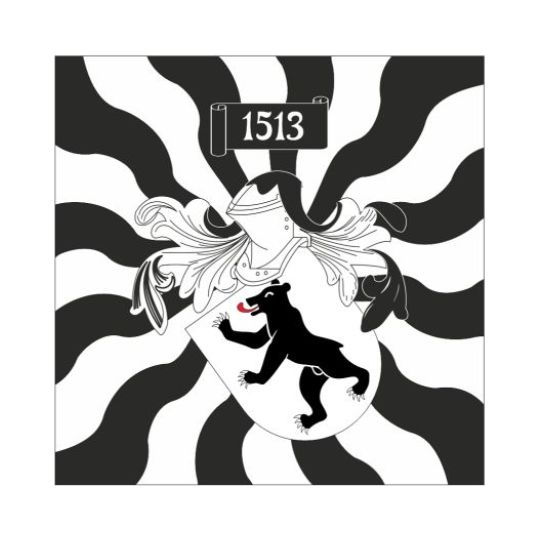
The name Appenzell comes from the Latin Abbatis Cella, meaning "abbot's domain." This refers to the Monastery of St. Gall, which controlled these lands in the early Middle Ages. The mountain communities gradually developed their own identity, and in the early 15th century, the residents rebelled against monastic authority and achieved independence.

The heraldic history of Appenzell begins with the bear. This animal was the symbol of the Abbey of St. Gall and is associated with the legend of the saint himself: according to legend, the bear helped him build a cell, earning the right to live near the monastery. When the Appenzellians rebelled against the abbey's authority in the early 15th century, they did not invent a new symbol. Instead, they adopted the bear as a kind of heraldic legacy.
In the monastery courtyard of Muri Abbey in Argau, one can see a curious composition: the coat of arms of the Princely Abbey of St. Gall, featuring a bear, stands alongside other symbols of the monastery's holdings. Adjacent to these are depicted the saints themselves— Gall and Othmar . So the symbol of Appenzell didn't appear out of nowhere: it literally grew out of the region's monastic heraldry.

Until the late 16th century, Appenzell was a unified canton with a single coat of arms — a black bear on a silver field. The same flag was used during the Swabian War of 1499 and was finally adopted after the canton joined the Swiss Confederation in 1513.
But the Reformation brought its own changes. Some communities adopted Protestantism, while others remained Catholic. The conflict was so serious that in 1597 the canton was divided into two parts: Appenzell Innerrhoden and Appenzell Ausserrhoden. Innerrhoden retained the old coat of arms with a bear, while Ausserrhoden had to add the letters VR to it.

Sometimes a combined shield with two bears was used to represent the historical canton. According to the rules of heraldic politeness, the animals were turned toward each other. However, their poses are so energetic and combative that it creates the impression that in another second the historical dispute will escalate into hand-to-hand combat.

In Innerrhoden, the bear is treated with almost scientific rigor. It's crucial that the coat of arms depict a male bear. And this is no joke. In 1977, a calendar was released in which the bear looked too, shall we say, neutral. Or, more accurately, like a female bear.

The cantonal council sent the publisher an official letter demanding the destruction of all unsold copies and the return to strict conformity. According to the authorities, the coat of arms must be unambiguous.
The bear is also actively used in municipal heraldry. For example, on the coat of arms of the cantonal capital, Appenzell, the familiar animal holds a red circle. Formally, this is a symbol of the capital's unity and status. But without a heraldic dictionary at hand, it seems as if the bear is simply reaching for a tasty bagel.
APPENZELL-INNERRHODEN: FUN FACTS
Of that wooden horses sometimes also want to drink.

In Appenzell, the festival begins not with the quiet ringing of bells, but with a veritable equestrian invasion. On the eve of the February carnival, horses of all colors — white, bay, black, and piebald — gallop through the streets of the capital. However, most of them are… wooden.
These are the famous "Botzerössli" — carnival toy horses. Riders literally "climb" into them through a hole in the back, strap themselves onto their shoulders, and hide their legs under a wide, colorful skirt that covers both rider and horse. From a distance, it looks like a whole herd of horses is racing through the streets.
Children and adults alike wear old firefighter uniforms and adorn their faces with moustaches, freckles, and rosy cheeks. The carnival begins with a drum roll, after which the cavalcade races up and down the village, accompanied by the jingling of bells. This tradition comes from southern Germany, where in the 19th century, mounted soldiers would make rather sarcastic comments to passersby. Today, "Botzerössli" survive only in Appenzell. And it is perhaps the only place in the world where wooden horses sometimes have to be led to a fountain to be "watered" after a too-wild ride.


Comments