ARGAU
Updated: Sep 12


Aargau is a canton of rivers and castles in northern Switzerland, east of Zurich: historic fortresses and important chapters of Swiss politics written amidst castles and vineyards.
ARGAU: ICONIC LANDMARKS
Land of old castles and the valleys of the Aare and Rhine rivers.

Aargau, or Aargau (you have to stretch the first "A" a bit to sound like a local), is a canton of rivers, castles, and layers of history, stacked like pages of a chronicle. Here, the Rhine and Aare draw smooth lines on the map, and between them, fortresses rise like exclamation points.
Lenzburg Castle rises above the valley like a stone chronicle of feudal Europe. Its towers have witnessed dynasties, intrigues, wars, and quiet eras of prosperity. In the village of Windisch, you can touch the Roman past — the legionary camps and amphitheater remind you that discipline and roads appeared here long before Swiss precision. In Augusta Raurica, the ancient theater still looks up to the sky, as if awaiting the next tragedy. Two thousand years — and the stage remains the same.

But Aargau doesn't dwell solely on the past. In Spreitenbach, the eco-arena showcases future technologies: solar panels, sustainable buildings, and smart consumption. Here, energy is literally harvested from the roof.
Aargau is where the Habsburg imperial dynasty began its journey to greatness at Habsburg Castle, and where modern times quietly continue this history. Balance is its defining architectural style.
ARGAU: COAT OF ARMS' HISTORY
The canton's symbols reflect the unions and territories that formed the region.

The territory of today's canton of Aargau was settled by Germanic tribes as early as the 5th century. The earliest mention of the name Argowe appears in a document from 763 — a modest but solid link connecting the modern canton to the early Middle Ages.

In the following centuries, the Lower Aargau changed hands: first it belonged to the Counts of Lenzburg, then to the Kyburg family, the Habsburgs... the list is long, and the German names are ponderous, but the essence is simple: the region was a tasty morsel and the subject of constant political claims.
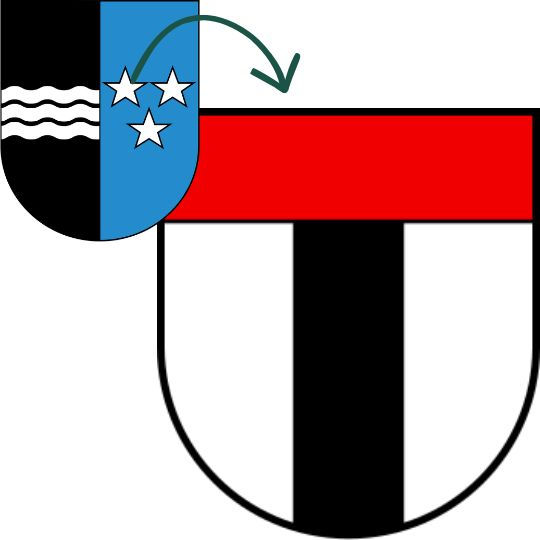
The situation changed in 1798, when Napoleon's troops arrived. Three separate cantons were formed from the former possessions: Aargau proper (also known as Freie-Emter), Baden, and Fricktal. Their unification, supplemented by small fragments of neighboring territories, led to the creation of the modern canton of Aargau in 1803.

The flag and coat of arms were officially approved in 1803, according to a design by Samuel Ringier-Sellmatter, during the period of the Act of Mediation. Later, in 1930, the design was slightly refined, but the basic elements remained unchanged.

The coat of arms is divided into two parts. The black field with a silver wavy stripe symbolizes the fertile soils through which the region's main rivers flow — the Aare, Reuss, and Limmat. The blue section with three five-pointed stars alludes to the historical regions united in the canton: Baden, Fricktal, and Freie-Emter . In short, the waves represent the Aare River, which gave the canton its name, and the stars are a tribute to both history and the current administrative divisions.

The coat of arms of the Freie Emter, or "Free Emter," derives from the banners presented by Pope Julius II to a Swiss regiment that distinguished itself in the Italian Wars. Its symbols first appear on 16th-century boundary stones: a golden torture column entwined with a silver rope. Interpreting this object is a complex matter, but it likely represents another instance where the visualization of intimidation served not cruelty but a warning.
ARGAU: FUN FACTS
Of the privilege of being on the coat of arms.

In the district of Aarau lies the municipality of Biberstein, which boasts one of the region's most unusual coats of arms. It depicts a beaver, engrossed in its work, symbolizing perseverance, mastery of construction, and a historical connection to Biberstein Castle, which gives the municipality its name.

Locals jokingly say, "Our coat of arms features the hardest-working creature in Argau ." And there's no denying it: the beaver is a far more original figure than a star or a wave.


Comments