LUZERN
Updated: Sep 11


Luzern is a canton and one of the most beautiful cities in Switzerland, looking like a postcard: a lake, mountains, and famous medieval bridges. And the lion sculpture in Luzern is one of the most touching in the world.
LUZERN: ICONIC LANDMARKS
The Chapel Bridge, the old town and the lake among the mountains make Luzern one of the most photogenic cities in the country.

Luzern lies in the very center of the country, on a bend in Lake Luzern, where the mountains come almost right down to the water. This canton seems to gather together the most iconic Swiss landscapes — lake shores, rocky peaks, and ancient towns.
The capital Luzern grew up on the River Reuss and has retained the rare feel of a medieval trading town.

The wooden Chapel Bridge, with its triangular murals beneath its roof, crosses the river just as it did seven centuries ago, connecting neighborhoods with painted facades and narrow squares. Above the rooftops rise the towers of the Musegg fortifications — a nearly intact belt of old fortifications, a reminder that Lucerne was once an important staging post on the route through the Alps.
Lake Luzern gives the entire canton its unique rhythm. Its shores are indented by bays, and old piers recall the time when steamships were the region's main transportation. Rising above the water is the Pilatus Massif, a mountain of legends and unexpected perspectives, offering views of several surrounding cantons and the complex line of lake shores.
LUZERN: COAT OF ARMS' HISTORY
The canton's symbol is linked to the colours of the old town and reflects its role as the trading centre of Central Switzerland.

Luzern's history begins as a trading hub. In the 11th and 12th centuries, the small settlement near the bridge over the Reuss River rapidly grew in wealth thanks to its advantageous location on the route to the Gotthard Pass .

The presence of the monastery of St. Leodegar only accelerated the settlement's growth, and by the 13th century, Luzern already played a prominent role in central Switzerland. In 1332, it joined the nascent Swiss Confederacy — a move that would determine its fate for centuries to come.

The oldest known use of the coat of arms dates back to 1386: the city seal features a small shield with vertically divided silver and blue fields at its base (although the seal itself is monochrome). However, Luzern's banner, divided horizontally into the same colors, is undoubtedly older, perhaps by more than a hundred years. However, the surviving fragment of the white and blue silk banner dates back to the same year, 1386.

Most of the coats of arms of the Swiss cantons are derived from their flags. Luzern's flag is divided horizontally, while its coat of arms is vertical, suggesting a lack of regard for the correspondence between the official symbols. However, the people of Luzern interpret this differently, and to their obvious advantage. Historically, medieval armies used standards to distinguish themselves on the battlefield — banners hung vertically on a horizontal pole. Banners on a vertical pole with a horizontal banner appeared later.
Thus, the coat of arms of Luzern is perceived by the observer as a standard, unlike, for example, the coats of arms of Fribourg and Solothurn, which means that the regalia of Luzern is definitely older and more solid than its other neighbors.

One heraldist wrote of the cantonal colors: "Blue as a lake, white as the snow of distant mountains: these are the colors of Luzern." This explanation, of course, does not correspond to historical accuracy, but it does unexpectedly confirm that even among dry and pedantic heraldists, there are also romantics.
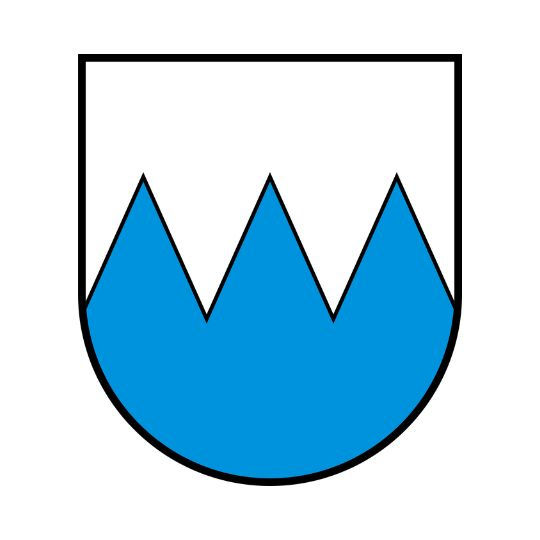
Other heraldists associated blue with the coats of arms of powerful urban families, particularly Gunwil and Littau. Almost nothing is known about the former, but the coat of arms of the municipality of Littau perfectly demonstrates its color and compositional similarity to the Lucerne coat of arms. In any case, the combination of blue and white became so firmly established that the color duo has remained unchanged since the 15th century to this day.

Since 1814, the city of Lucerne and the canton of Luzern have been legally separate, but they share the same coat of arms. To avoid confusion, the city's version is adorned with a yellow mural crown, and according to the 1999 municipal code, the shield is supported by two golden lions — a typical, yet elegant, European tradition of shield supporters.
While Swiss cities rarely use such decorations, Luzern allows itself a slight deviation from minimalism. It's hard to argue with that: both the crown and the lions suit it.
LUZERN: FUN FACTS
That an interesting story is often not so funny.

Luzern is home to one of the most poignant works of monumental sculpture in the world: the Dying Lion by Danish sculptor Bertel Thorvaldsen , carved directly into a massive rock.

The wounded animal, covering the shields of France and Switzerland with its body, commemorates the tragic events of 1792, when a revolutionary mob stormed the Tuileries Palace. Only the Swiss Guard remained loyal to King Louis XVI and almost entirely perished defending him.
The inscription above the sculpture reads: "Helvetiorum fidei ac virtuti," "To the loyalty and courage of the Swiss." The numbers 760 and 350 represent the number of those killed and those who survived. The memorial evokes deep respect even among those ignorant of history: the very silence of the stone reminds us of the price of honor.
LUZERN: ALPINE SKIING
The Sorenberg-Rothorn mountain region becomes a popular ski area in winter.

One of the largest resorts in the Lucerne region, Sörenberg is the gateway to the 2,350-meter-high Rothorn. The peak offers sweeping views, and pistes wind down through forests and cliffs. The total length of slopes exceeds 40 kilometers, yet there's a clear focus on freeriding. At the summit, the mountain panorama and the sense of spaciousness combine with the feeling of "I'm here, living life to the fullest."

Beginners and experienced skiers alike will appreciate the perfectly groomed slopes with artificial snow systems. For freeriders and experts alike , the Brienzer Rothorn area offers an unforgettable snowy adventure. The village ski area is ideal for a family vacation. There are two children's lifts, perfect for the little ones to navigate independently. It's a place you won't want to leave, where you can relax and feel right at home.


Comments